An IT company can help a business operate more safely, serve customers better, and reduce repeated work. However, “IT services” covers many different areas. Choosing an IT company in Malaysia begins with understanding which type of support your business needs.
Some providers manage computers, networks, and cloud accounts. Others build software, websites, online stores, or automation. A provider may be excellent in one area and unsuitable in another.
This guide explains the main services, selection criteria, costs, and questions that Malaysian businesses should consider.
IT company in Malaysia for practical business technology support.
Write down the business problem before contacting providers. Staff may lose time because systems fail. Customer data may be spread across several tools. A website may not generate enough leads. Reports may be slow and unreliable.
Describe who is affected, how often the problem occurs, and what a better result would look like. This helps the IT company recommend a useful solution.
Avoid buying a tool only because it is popular or cutting edge. Technology should support a clear business goal.
An “IT services company Malaysia” provider may handle infrastructure, cloud tools, and security. An “IT solutions company Malaysia” may design a wider setup. An “IT support company Malaysia” usually focuses on technical problems and user support.
“Managed IT services Malaysia” provides ongoing monitoring and maintenance. A “technology company Malaysia” may cover software, hardware, or consulting. A “digital transformation company Malaysia” focuses on improving business workflows with connected digital tools.
These companies support devices, users, networks, email, backups, and common business software. Services may be remote, on-site, or both.
They help businesses set up cloud platforms, servers, storage, access, backups, and online work environments.
Security companies focus on risk assessment, account protection, monitoring, testing, training, incident response, and data recovery.
They create business systems, mobile apps, customer portals, dashboards, and integrations. Review the software development company Malaysia guide for detailed project questions.
These providers build websites, ecommerce stores, content, SEO, digital advertising, and customer journeys.
They connect tools, reduce repeated tasks, improve reporting, and help information move between departments.
Choose the category that matches the main problem. A single company does not need to provide every service.
A nearby provider is helpful when office visits, devices, or physical infrastructure are important. Companies in Selangor may compare the IT company in Shah Alam guide, while Kuala Lumpur businesses can use the IT company in Kuala Lumpur guide.
A nationwide or remote provider can still support websites, cloud tools, software, and automation. Online support can be fast when the process and response times are clear.
Choose based on the service, experience, communication, and risk. Location should support the decision, not replace careful review.
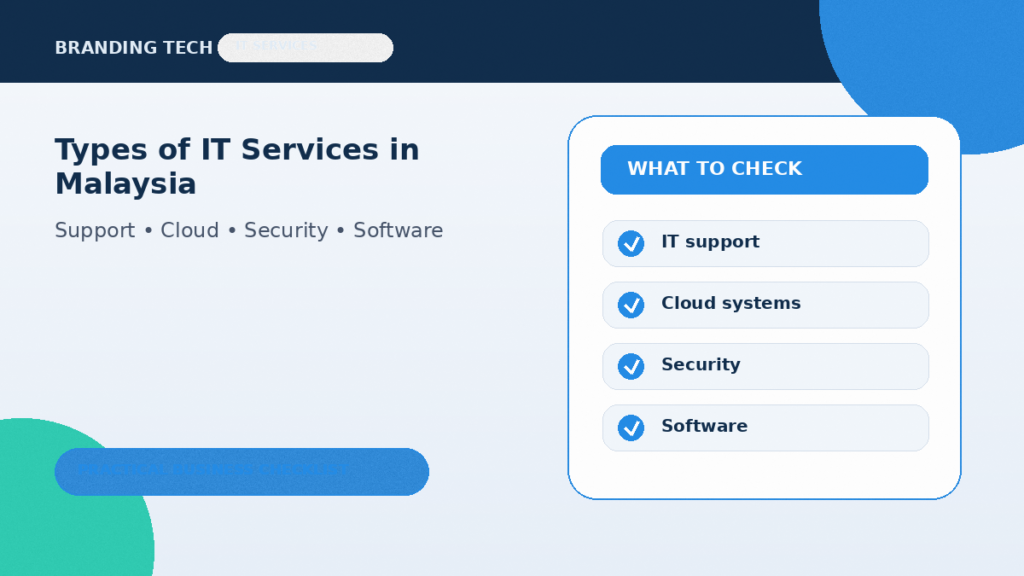
Main types of IT services available to Malaysian businesses.
Ask for work related to your exact need. A provider with strong office support experience may not be suitable for ecommerce or custom software.
Review case studies, demonstrations, or references. Ask what the provider’s own team completed.
A good company asks about users, systems, data, risks, budget, and goals. It should study the current process before recommending major changes.
For larger projects, a discovery or assessment stage helps create a reliable plan.
The scope should list tasks, deliverables, responsibilities, timeline, exclusions, one-time costs, recurring fees, testing, training, and support.
For monthly services, confirm covered users, devices, systems, hours, response times, and visit limits.
Your business should control domains, hosting, cloud accounts, software subscriptions, data, analytics, and administrator accounts.
Give suppliers access based on need. Keep a record of permissions and remove access when it is no longer required.
Ask about two-step login, access rules, updates, backups, monitoring, and incident response. Security must match the type of data and business risk.
Confirm how often backups are created and whether recovery is tested.
The provider should explain technical issues in simple language. Know who manages the account, how staff request help, and when updates are provided.
Clear communication reduces downtime and prevents misunderstandings.
Measures may include response time, system availability, solved issues, fewer manual steps, website leads, online sales, page speed, or reporting time.
Agree on the measures before work begins.
Costs vary widely. Monthly support depends on users, devices, hours, systems, and response level. Projects depend on scope, features, integrations, data, security, and testing.
Separate setup, equipment, licences, hosting, maintenance, training, and optional work. Ask which prices may change when user numbers or usage increase.
Do not compare only the total. A lower quote may exclude support, security, documentation, or testing. Compare the same scope and business risk.
Technology changes after launch. Software needs updates, websites need maintenance, users need help, and business processes improve.
Agree on who will monitor systems, renew licences, maintain backups, update documentation, and review access.
Keep important knowledge inside the business. Your team should understand basic system ownership and know where credentials and documents are stored.
If the provider relationship ends, plan a controlled transfer. Receive current data, files, credentials, documentation, and outstanding issue information.
One mistake is choosing a company because it offers the longest service list. Relevant experience is more important.
Another mistake is allowing the provider to own important accounts. This can make future changes difficult.
Businesses may also automate a poor process. Improve responsibilities and data quality before adding technology.
Some companies do not involve users. Staff who perform the daily work should join discovery and testing.
Finally, do not ignore training. A good system creates little value when people do not know how to use it.
The MDEC Business Digitalisation Initiative provides a framework for businesses to assess digital maturity and improve productivity. It covers customer-facing, operational, and IT areas.
Use this practical approach. Begin with the area that creates the most value, choose a suitable solution, train users, and measure the result.
Businesses specifically comparing nearby development teams can also read the software companies near me guide.
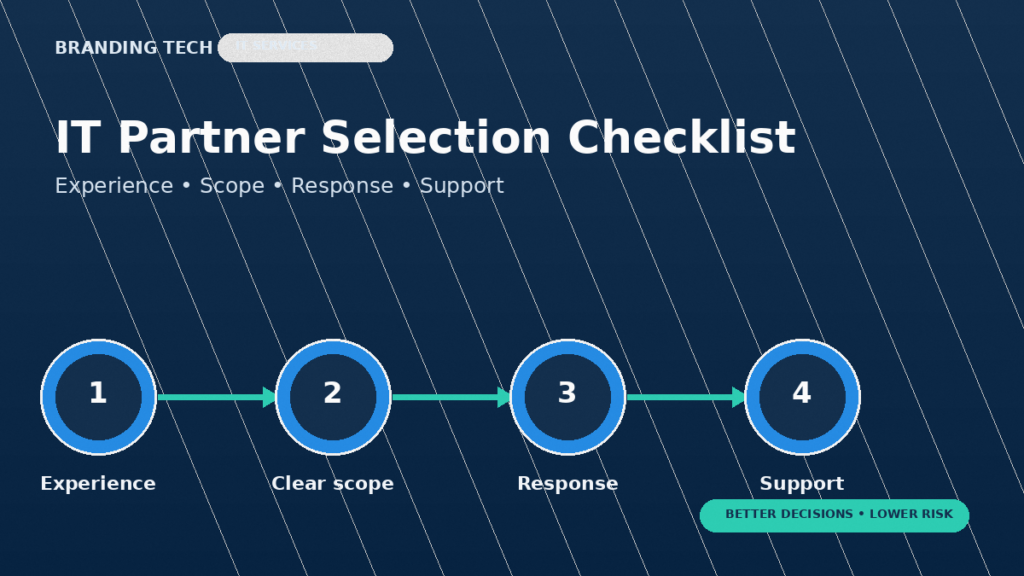
How to compare IT companies in Malaysia.
Branding Tech connects digital technology with customer growth. We provide websites, SEO, digital advertising, branding, content, and AI automation.
We help businesses improve online visibility, collect leads, organise customer communication, and reduce repeated marketing or follow-up work.
We are not a hardware repair or full-time infrastructure monitoring company. For advanced networks, servers, or specialist cybersecurity, choose a provider with that exact expertise.
Services may include technical support, cloud tools, security, software, websites, ecommerce, integrations, automation, and reporting. Each provider has different strengths.
Not always. One partner may manage several connected services, but specialist work may require a specialist provider. Keep responsibilities and account ownership clear.
It can be useful when staff need regular help or important systems require maintenance. Compare the covered services, users, hours, response time, and cost.
Give each provider the same problem statement and requirements. Compare experience, scope, security, ownership, communication, support, price, and results.
The best IT company in Malaysia is the provider that fits your business problem. It should explain the solution clearly, protect your digital assets, and support the work after launch.
Start with one important need. Compare providers using the same questions, keep control of your accounts and data, and measure the result. Practical technology should make the business easier to run and easier for customers to use.
A web developer turns a website plan into a working digital platform. The developer may build pages, forms, ecommerce functions, booking tools, portals, integrations, and performance improvements. Choosing the right web developer in Malaysia is important because the work affects security, speed, customer experience, and future maintenance.
Some projects need only a small business website. Others require custom programming and connections with several systems. The provider should match the complexity of the project.
This guide explains the main development options, the questions to ask, and the risks to avoid.
Web developer Malaysia for reliable business websites.
A web designer focuses on layout, visual style, and user experience. A web developer builds the technical structure and functions.
Ask who is responsible for each part. Clear roles help prevent gaps between the approved design and the working website.
The web designer KL guide gives more detail about visual design, content, and customer journeys.
A “website developer Malaysia” provider may build standard business websites. A “web development company Malaysia” usually offers a wider team. A “WordPress developer Malaysia” may be the right choice when WordPress is the selected platform.
A “professional web developer Malaysia” should explain security, testing, ownership, and maintenance. A “custom web developer Malaysia” builds special features. An “ecommerce web developer Malaysia” should understand products, checkout, payments, shipping, and integrations.
These sites explain services, build trust, and generate enquiries. Development may include content management, forms, mobile layouts, maps, analytics, and SEO setup.
Online stores need products, payments, delivery rules, stock, customer accounts, order emails, security, and testing.
Web applications perform business functions such as booking, customer access, approvals, calculations, dashboards, or workflow management.
Integration connects the website with payment, CRM, accounting, email, messaging, courier, or other tools. This can reduce manual work.
Developers may also improve speed, fix errors, update software, protect the site, manage backups, and add features.
A simple website may use WordPress or a hosted builder. These options can reduce development time and provide familiar content management.
A custom framework may be suitable when the project has special business rules, high integration needs, or a unique application.
Do not choose technology because it sounds modern. Ask how it fits the website goal, team skills, security, expected traffic, maintenance, and budget.
The website builder Malaysia guide explains when a standard platform may be enough. For advanced systems, the web programming company guide covers custom workflows and technical ownership.
Open completed websites and test them on mobile and desktop. Look at speed, navigation, forms, features, and the full customer journey.
Ask what the developer personally built. A portfolio may include design work completed by another company.
A good developer asks about users, pages, content, goals, features, integrations, data, and support. Technical work should support the business process.
For complex projects, expect a discovery stage before the final scope.
The proposal should list pages, functions, platform, content responsibilities, SEO setup, mobile testing, browser testing, security, tracking, training, timeline, and support.
Confirm exclusions. Product uploads, copywriting, paid plugins, translation, hosting, and third-party fees may be separate.
Know who manages the project and how often you will see progress. Regular demonstrations help identify misunderstandings before launch.
Ask how changes are requested, approved, and priced.
Your business should control the domain, hosting, website administrator account, analytics, payment account, and other important services.
The agreement should explain ownership of design, content, custom code, database, and documentation.

The difference between a web designer and web developer.
The website should adapt to common phones, tablets, and desktop screens. Important buttons and forms must remain easy to use.
The developer should optimise images, code, hosting, and other resources. Ask how performance will be tested.
The site needs secure connections, strong administrator access, updates, backups, and suitable protection for its data and functions.
Developers should support readable URLs, titles, headings, mobile performance, redirects, indexing, structured pages, and other technical SEO needs.
Text, colours, forms, labels, and navigation should be understandable for a wide range of users. Simple design often works better than unnecessary effects.
Test links, forms, emails, payments, calculations, user roles, integrations, and error messages. Your own team should test realistic tasks before approval.
Ask which parts your staff can update. Common tasks may include changing text, uploading images, publishing articles, adding products, and checking enquiries.
The developer should provide administrator access and basic training. Documentation is useful for repeated tasks and future staff.
Limit administrator access to people who need it. Create separate accounts instead of sharing one password.
Cost depends on pages, design, content, ecommerce, user roles, integrations, languages, custom functions, data, testing, and support.
A template-based company site usually costs less than a custom portal. An ecommerce project costs more because it needs payment, delivery, order management, and security.
Ask for setup and recurring costs. Recurring expenses may include domain, hosting, licences, applications, maintenance, and support.
Compare the complete scope. A low quote may exclude testing, content, SEO, security, or post-launch support.
The website needs monitoring, backups, software updates, security checks, and occasional improvements.
Ask whether the developer provides a warranty for bugs and a separate maintenance plan. Define how urgent issues are reported and how quickly the team responds.
Keep current backups and documentation. If you change providers, another developer should be able to understand and support the website.
One mistake is choosing a developer before defining the website goal. The project can grow without a clear priority.
Another mistake is starting development without content. Weak or late content changes the layout and causes delay.
Businesses also forget to protect ownership. Domains, hosting, and accounts should remain under company control.
Some sites launch without analytics or conversion tracking. This makes future marketing difficult to measure.
Finally, companies may stop communication after launch. Review website results, customer questions, errors, and improvement opportunities regularly.
The MDEC Business Digitalisation Initiative encourages Malaysian businesses to adopt tools that improve efficiency and competitiveness. A website supports this goal when it reduces friction for customers and staff.
If the business plans to sell online, the ecommerce web design Malaysia guide explains products, payments, delivery, and checkout. If the website needs promotion, continue to the website marketing Malaysia guide.
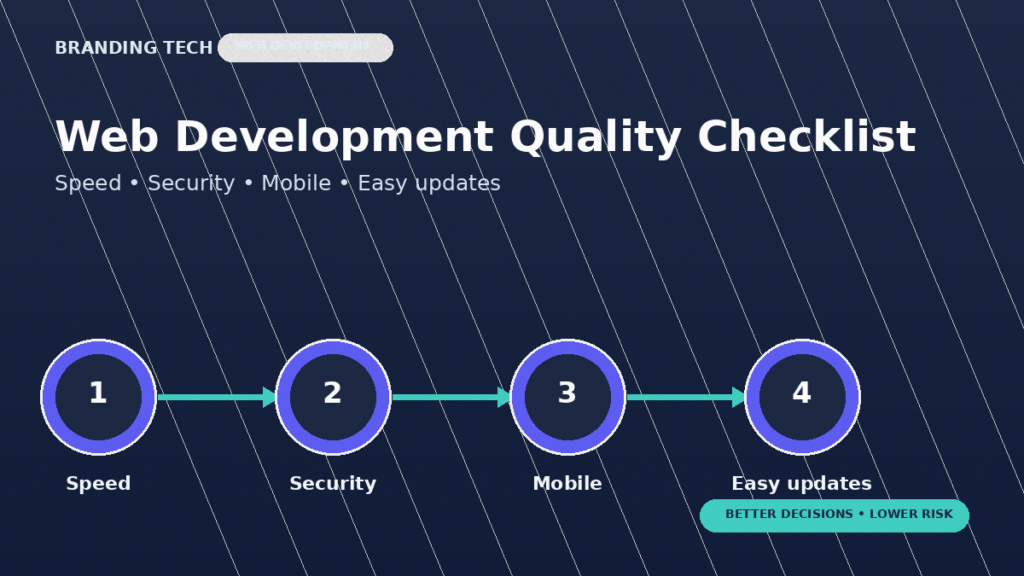
Technical quality points to check in web development.
Branding Tech provides website design and development, content, SEO, digital advertising, branding, and AI automation.
We plan websites around the customer journey and business goal. This includes clear pages, responsive design, lead tracking, and connections with marketing tools.
For specialist enterprise systems or complex software, we recommend using a development team with proven experience in that exact area. Honest scope creates better results than claiming every project is the same.
A small business website may take a few weeks. Ecommerce, multilingual, or custom projects take longer because of content, functions, integrations, testing, and approvals.
WordPress is suitable for many business and ecommerce sites. Custom development may be needed for special workflows or advanced integrations. Choose based on requirements and long-term support.
Some developers manage hosting, while others help you purchase it directly. Your business should understand the account, renewal, support, and backup arrangements.
Yes. Websites need backups, updates, security, error fixes, and content changes. Agree on responsibilities and response times before launch.
The right web developer in Malaysia should understand both the technical work and the business goal. It should provide clear scope, safe ownership, careful testing, and reliable support.
Compare relevant work, communication, technology, security, SEO, cost, and maintenance. A strong website should be easy for customers to use and practical for your team to manage.
Searching for “software companies near me” is a useful first step, but distance alone does not show whether a provider is suitable. The company must understand your business problem, have relevant technical experience, communicate clearly, and support the system after launch.
A nearby team can make meetings and office visits easier. A remote team may still deliver excellent software through a strong online process. The right choice depends on the project and the level of support required.
This guide explains how to turn a local search into a careful business decision.
Software companies near me selected by skill and support.
Software companies have different strengths. Some build mobile apps. Others create business systems, websites, ecommerce platforms, integrations, automation, or data dashboards.
Start with the problem. Explain what staff or customers do today, where delays or mistakes happen, and what result you want.
You may need a booking system, customer portal, inventory tool, approval workflow, reporting dashboard, mobile app, or connection between existing platforms.
The clearer the problem, the easier it is to find a company with matching experience.
Searching for “software developers near me” can show freelancers and full teams. A “custom software company near me” may be suitable for a system built around your own process. A “local app development company” usually focuses on mobile or web applications.
A “business software provider near me” may sell ready-made tools. “Software solutions near me” can include development, integration, support, and consulting. Review the actual scope because these labels are not used consistently.
A local software company can meet your users, observe office processes, and support work that requires physical access. This may help complex projects involving several departments.
A remote team can also run discovery meetings, design reviews, demonstrations, testing, and support online. It may offer specialist experience that is not available nearby.
Do not limit the search too early. First identify the skills and support you need. Then compare nearby and remote providers using the same requirements.
For Malaysian projects, the software development company Malaysia guide provides a wider comparison of development scope, ownership, and maintenance.
Search engines and Google Maps can show nearby providers. Professional networks, business associations, technology directories, and trusted referrals may also help.
Use specific searches. Add the project type, such as booking system developer, mobile app company, or CRM integration.
Create a shortlist based on relevant work. Some companies sell products rather than develop custom systems.
Ask for examples with similar users, workflows, integrations, or security needs. Industry experience can help, but problem-solving experience is often more important.
Ask what the company’s own team completed and whether it still supports the project.
A serious provider studies the process before building. It may interview users, map workflows, review data, prepare prototypes, and identify risks.
Be careful with a fast price for a complex system when the provider has not asked detailed questions.
The team should explain options in simple language. Confirm who manages the project, how often you will receive updates, and how decisions are recorded.
Good communication reduces expensive misunderstandings.
Ask who will maintain the system, fix problems, update security, manage backups, and support users after launch.
Know the support hours and response time. A nearby office does not guarantee fast support unless the agreement defines it.
A useful proposal should describe:
If important areas are missing, ask for clarification before signing.

How to review local software companies before requesting a quote.
Ownership must be clear. The contract should explain who owns custom code, design, database, documentation, and intellectual property after payment.
Your company should control the domain, production hosting, cloud services, and business data. The provider can receive access without becoming the only owner.
Ask about third-party libraries, licences, and services. Some components may remain under external terms.
Plan for transfer. If you change providers, you should receive current code, documentation, credentials, data, and deployment information.
The software team should plan user permissions, secure login, backups, updates, error logging, and recovery.
Ask how developers access production systems and how access is removed when someone leaves the project. Discuss where data is stored and which people can view it.
If the system handles personal, financial, health, or payment information, choose a provider with experience appropriate to that risk.
Security should be part of design and development, not an extra task added after launch.
Cost depends on features, users, data, integrations, design, platforms, security, testing, and support. Location is only one factor.
Local companies may have different rates from remote teams, but the cheapest rate does not always create the lowest total cost. Poor requirements or weak testing can lead to expensive rework.
Ask for a stage-based estimate. Separate discovery, design, development, migration, hosting, licences, training, and maintenance.
For unclear projects, begin with paid discovery. The output should give you a better scope and plan.
One mistake is choosing the closest company without checking relevant skills. The provider may not have experience with your project type.
Another mistake is sending a short message asking only for price. Give every shortlisted company the same brief so quotations are comparable.
Companies also forget to involve real users. Staff who perform the work should test the system before final approval.
Finally, do not ignore maintenance and transfer. Software remains valuable only when it can be supported safely over time.
Create a brief that explains the company, problem, users, essential features, integrations, data, budget range, and timeline.
Shortlist three to five providers with relevant work. Hold the same discussion with each one.
Score them on understanding, experience, process, communication, ownership, security, support, price, and risk.
Check references for larger projects. Ask past clients about communication, change management, testing, and post-launch support.
Choose the provider with the strongest overall fit, not simply the nearest address.
The MDEC Business Digitalisation Initiative encourages Malaysian companies to assess their digital maturity and adopt tools that improve productivity. This is a helpful approach when choosing software.
Begin with a process that creates measurable value. Test the result, train users, and improve the system in stages.
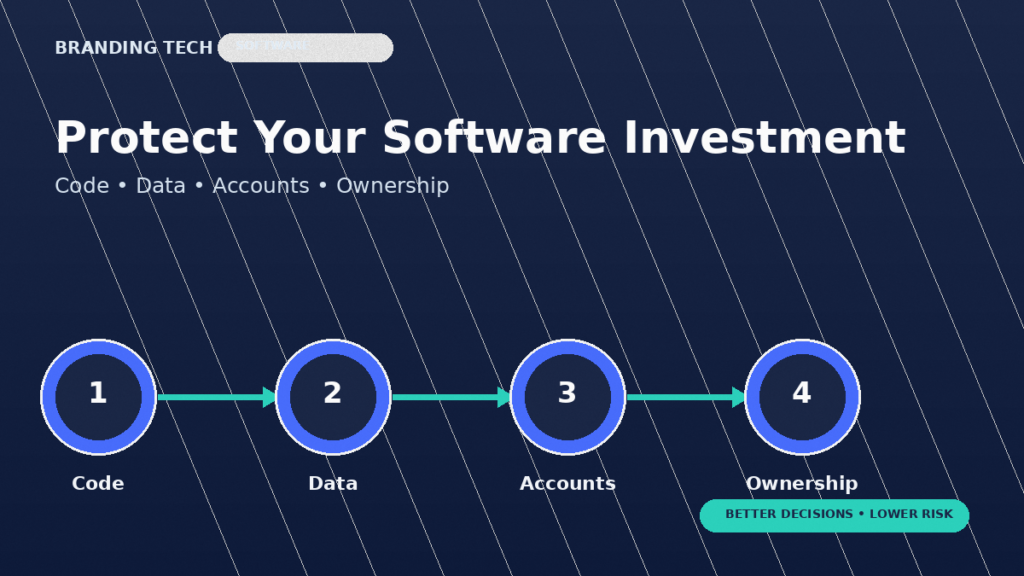
Protect code, data, and ownership in a software project.
Branding Tech supports websites, digital marketing, SEO, branding, content, and AI automation. We can help businesses improve online customer journeys and connect lead-generation or follow-up tools.
For advanced custom software, mobile applications, or enterprise systems, choose a dedicated provider with proven development experience. Our role can focus on the website, marketing, customer communication, or automation parts that match our scope.
No. Local access can help meetings and on-site support, but relevant experience, process, security, communication, and maintenance are more important.
Three to five serious providers are usually enough. Give them the same brief and compare the full proposal, not only the price.
A fixed price can work when requirements are clear. For uncertain projects, begin with discovery and use a staged estimate or controlled change process.
The contract should define ownership of code, design, data, documentation, and accounts. Your company should control its production systems and business information.
“Software companies near me” can help you find options, but it should not make the final decision. A suitable partner must understand the problem and support the full project journey.
Compare relevant experience, discovery, communication, security, ownership, testing, maintenance, and transfer. Choose the team that reduces risk and creates a system your business can use confidently.
A website builder can help a Malaysian business launch a simple site without starting from zero. Many platforms provide templates, page editors, hosting, and basic tools in one service. They can be useful, but they are not the best answer for every project.
The important question is not which builder is most popular. It is whether the platform can support your website goal, customer journey, staff skills, and future growth.
This guide explains when a website builder is suitable, when professional development may be safer, and what costs or limits to check.

Website builder Malaysia options for small businesses.
A website builder is a platform that lets users create pages through templates and visual editing tools. It may include hosting, security, forms, ecommerce, analytics, and applications.
Some builders are fully hosted. The platform manages the technical environment while you pay a monthly or yearly fee. WordPress is different because it can be installed with many hosting providers and extended with themes and plugins.
Each option offers a different balance of ease, control, flexibility, cost, and maintenance.
The “best website builder Malaysia” option depends on the project. An “easy website builder Malaysia” platform may suit a simple site. A “business website builder Malaysia” service should support professional pages, forms, analytics, and future updates.
An “ecommerce website builder Malaysia” platform must also handle products, payments, and shipping. A “WordPress website Malaysia” project offers flexibility but needs maintenance. An “affordable website platform Malaysia” should be judged by long-term cost, not only the first fee.
A builder may work well for a small company profile, personal site, simple landing page, event page, or early business test.
It is especially useful when requirements are standard, the budget is limited, and someone inside the company has time to manage content.
Templates can speed up design. Built-in tools may reduce the need for technical setup. The business can launch a basic site and improve it as it learns.
However, easy editing does not automatically create good content or a strong customer journey. The company still needs to plan the message, pages, calls to action, images, and search visibility.
Professional support may be safer when the website is important for sales, handles payments, needs several languages, contains many pages, or connects with other systems.
A professional team can help with strategy, content, design, development, SEO, analytics, testing, security, and maintenance.
Custom work may also be required for special booking, membership, quotation, portal, or workflow features. In these cases, the limits of a builder can create extra work later.
The web developer Malaysia and web programming company guides explain how to select technical support for more advanced projects.
Test how staff will update text, images, products, menus, and blog posts. A simple editor is useful only when the team can manage it consistently.
Templates should work on phones and tablets. Check buttons, forms, menus, product pages, and checkout on real devices.
The platform should allow page titles, meta descriptions, headings, readable URLs, image alt text, redirects, and search indexing controls.
Online stores need products, variations, stock, payment methods, delivery rules, discounts, order management, and customer communication.
Check whether the builder connects with analytics, advertising, CRM, email, booking, payment, and automation tools used by the business.
Understand what happens if you stop paying or want to move. Can you export content, products, customer data, and design? Some platforms make migration difficult.
Hosted builders manage much of the technical platform, but your company still manages content, settings, accounts, and applications. WordPress offers more control but needs regular updates and backups.
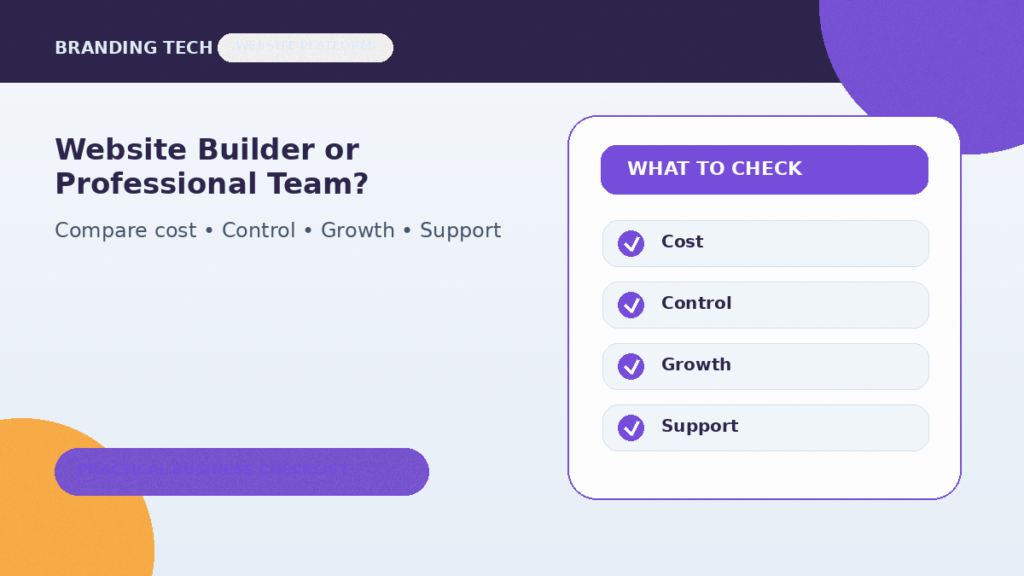
Compare a website builder with professional website development.
The visible subscription is only one cost. You may also pay for a domain, premium template, applications, ecommerce features, transaction fees, email, stock images, content, and professional setup.
Some platforms become more expensive as the business adds products, staff accounts, storage, or advanced features.
Compare costs over two or three years, not only the first promotional period. Include the time your staff will spend learning and maintaining the site.
Professional development has a higher setup cost but may provide a more suitable structure, stronger content, and better long-term support.
Many businesses choose a template and then struggle to fill its sections. Begin with the customer questions instead.
Explain what you offer, who it is for, what problem it solves, how the process works, why people should trust you, and what they should do next.
Plan the homepage, services or products, About page, contact page, FAQs, policies, and useful supporting content.
Use short paragraphs and clear headings. Do not add a section only because the template contains it.
A builder can support basic SEO, but the platform cannot replace strategy and useful content. Search visibility depends on page quality, technical performance, competition, local signals, authority, and ongoing work.
Use one main topic for each page. Avoid creating several pages that target nearly identical keywords. Connect related pages with helpful internal links.
Keep important business information consistent. For local companies, include the correct company name, location, phone number, hours, and service areas.
The website marketing Malaysia guide explains how SEO, advertising, content, and conversion tracking support a website after launch.
One mistake is choosing a platform before listing requirements. A builder may look easy during a trial but lack an important payment, language, or integration feature.
Another mistake is using a template without adapting it to the brand and audience. Generic pages can make the business look similar to competitors.
Businesses also add too many applications. Extra tools can increase costs, slow the website, or create security and compatibility problems.
Some users forget account ownership. Keep the domain, subscription, payment account, and administrator access under the business.
Finally, do not launch without testing. Check every form, email, button, link, map, payment, delivery rule, and mobile page.
Think about local payment methods, contact preferences, delivery, languages, and service areas. A Malaysian business may also need WhatsApp, Google Maps, local SEO, and suitable privacy information.
The MDEC Business Digitalisation Initiative encourages companies to assess their digital maturity before adopting tools. This is a useful approach for website builders. Choose a platform your staff can manage and your business can support.
If you are planning an online store, the ecommerce web design Malaysia guide explains payments, delivery, products, and checkout in greater detail.
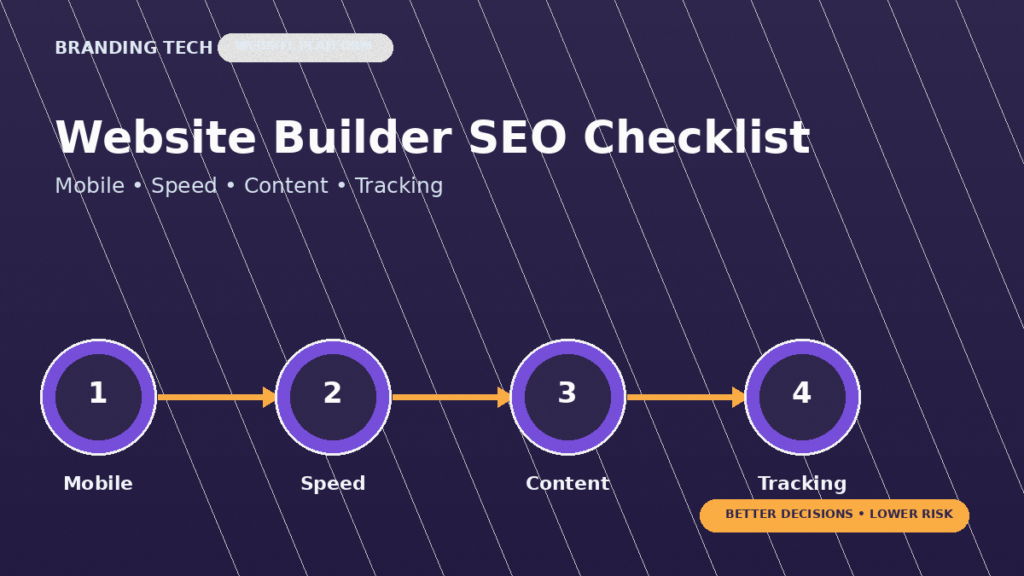
SEO features to check in a Malaysian website builder.
Branding Tech helps Malaysian businesses plan and build websites, create content, improve SEO, run digital advertising, and connect lead follow-up tools.
We can review whether a builder, WordPress website, ecommerce platform, or more custom solution fits the goal. The recommendation should consider both the launch and the work required after launch.
Our focus is a website that the business can own, understand, measure, and improve.
There is no single best platform. Compare your pages, ecommerce needs, payment options, languages, integrations, ownership, staff skills, recurring costs, and support.
Yes, especially for a simple site. Good results still require clear content, consistent branding, mobile testing, SEO setup, and regular maintenance.
WordPress is a content management system that can use visual page builders. It offers flexibility and ownership but needs suitable hosting, updates, security, and technical care.
It depends on the platform. Some allow content export but not full design or function transfer. Review portability before building a large site.
A website builder in Malaysia can be a smart option for a simple project with clear requirements. Professional design or development may be better when the website is central to sales, needs special features, or requires ongoing marketing.
Decide based on the full customer journey, ownership, long-term cost, staff capacity, and future needs. The easiest platform today is not always the easiest platform to grow with tomorrow.
A standard website presents information. A programmed web system can also manage bookings, customer accounts, approvals, payments, reports, or internal work. Choosing the right web programming company helps a business turn a complex process into a useful online tool.
The project should begin with the process, not the code. A development team needs to understand users, data, decisions, and business rules before it builds features.
This guide explains what web programming includes, when custom development is useful, and what to check before hiring a provider.
Web programming company for custom business systems.
Web programming is the technical work that makes an online platform perform actions. It may process forms, manage user accounts, store information, calculate prices, connect payments, generate reports, or exchange data with other systems.
A normal company website may need limited programming. A portal, marketplace, booking engine, dashboard, or workflow system needs more detailed development and testing.
Web design and web programming are connected but different. Design plans the user experience and visual layout. Programming makes the functions work safely and reliably.
A “web application development company” builds browser-based tools for specific users and workflows. “Custom web programming services” may cover smaller features or integrations. A “web software development company” often manages design, coding, testing, and launch.
A “business web application developer” may focus on one company’s internal needs. A “custom portal development company” builds secure spaces for customers, staff, or partners. “Web system development services” may include all these tasks and maintenance.
Custom development may be useful when ready-made tools do not match the process. Examples include special quotation rules, multi-stage approvals, customer portals, distributor systems, booking workflows, and connections with existing databases.
It can also reduce manual work. If staff copy information between forms, spreadsheets, email, and accounting tools, an integration may save time and reduce mistakes.
However, custom programming is not always necessary. A website builder or existing software may solve a common need at lower cost. Review ready-made options before building from the beginning.
The website builder Malaysia guide can help you compare standard platforms with professional custom work.
The right solution depends on the business rule behind each feature. Two booking systems may look similar but handle availability, prices, users, and approvals differently.
Start by describing the current process. Explain who performs each step, which information is used, where delays happen, and what result the new system should create.
List user types such as customers, staff, managers, suppliers, or administrators. Each user may need different permissions and screens.
Identify the systems that need to connect. These may include payment gateways, CRM platforms, accounting tools, courier services, email, messaging, or external databases.
Separate essential first-stage features from future ideas. A focused first release is easier to test and improves the chance of a successful launch.
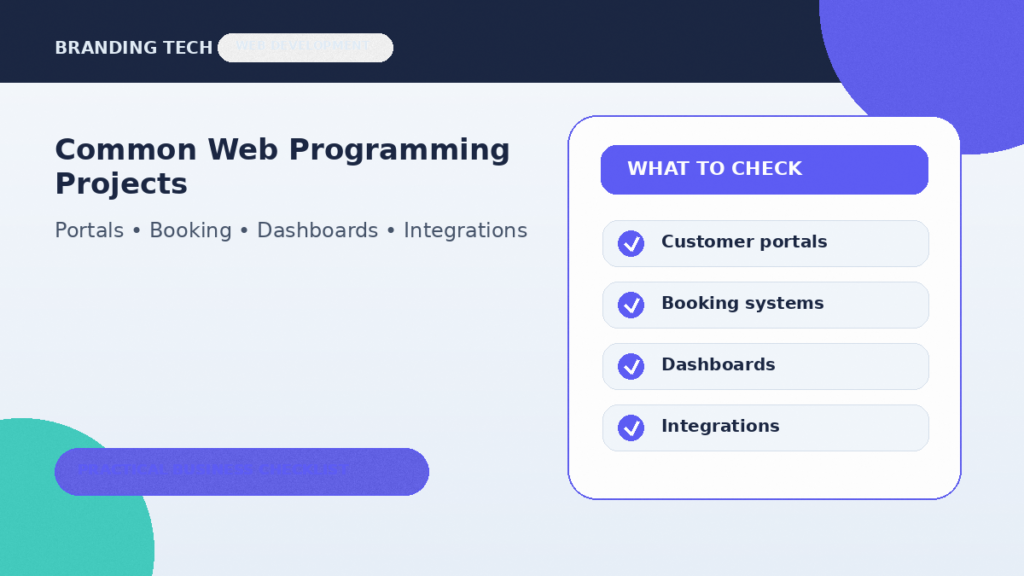
Common custom web programming projects for businesses.
Ask for examples of systems with similar workflows, user roles, payments, or integrations. A marketing website portfolio does not prove custom programming experience.
Request a demonstration where possible. Ask what the team built and which third-party tools it used.
The company should study the business before estimating a complex project. Discovery may include meetings, process mapping, user stories, prototypes, and technical review.
Be careful with a fixed low quote given before the provider understands the requirements.
You do not need to choose the programming language yourself. Ask the team to explain why its recommended technology fits the project, security, expected traffic, integrations, budget, and future support.
Avoid choosing technology only because it is described as new or cutting edge. Reliability, available skills, and maintainability matter.
Agree on stages, demonstrations, approvals, and change requests. Regular progress reviews help the business find misunderstandings early.
Know who will manage the project and how technical questions will be explained to non-technical staff.
The contract should explain ownership of source code, design, database, documentation, accounts, and intellectual property.
Your business should control production hosting, domains, and important service accounts. Ask about licensed components and any code the provider reuses across projects.
Discuss login, permissions, data protection, backups, secure development, error handling, and monitoring. Testing should cover functions, different users, devices, integrations, and unexpected inputs.
Your own staff should complete user acceptance testing with realistic tasks.
Cost depends on features, user roles, design, data, integrations, security, testing, and support. A simple calculator or portal costs less than a marketplace with payments and several user types.
Ask the provider to separate discovery, design, development, data work, hosting, licences, testing, training, and maintenance.
For an unclear project, a paid discovery stage may produce a more reliable estimate. This is often safer than accepting a cheap fixed price based on assumptions.
Compare total value and long-term maintenance, not only initial development cost.
One mistake is building too many features before testing the main workflow. Launch a focused version and learn from real users.
Another mistake is changing requirements through casual messages without updating the scope. Record changes and their effect on price and timeline.
Businesses may also forget data preparation. Old or duplicated records can delay migration and create unreliable reports.
Some companies allow one supplier to control all accounts and code without documentation. Protect access and plan how another team could support the system later.
Finally, do not ignore maintenance. Internet browsers, security risks, integrations, and business needs change over time.
A custom web system may need more than development. Customers must still understand the offer and trust the interface. The project may require design, content, SEO, analytics, and marketing.
Businesses planning a larger system can read the software development company Malaysia guide. It covers ownership, data, testing, and long-term software support in more detail.
The web developer Malaysia guide helps companies compare professionals for both websites and web applications.
The MDEC Business Digitalisation Initiative encourages companies to assess digital maturity and adopt tools that improve productivity. Custom programming should follow the same principle by solving a clear and valuable process.
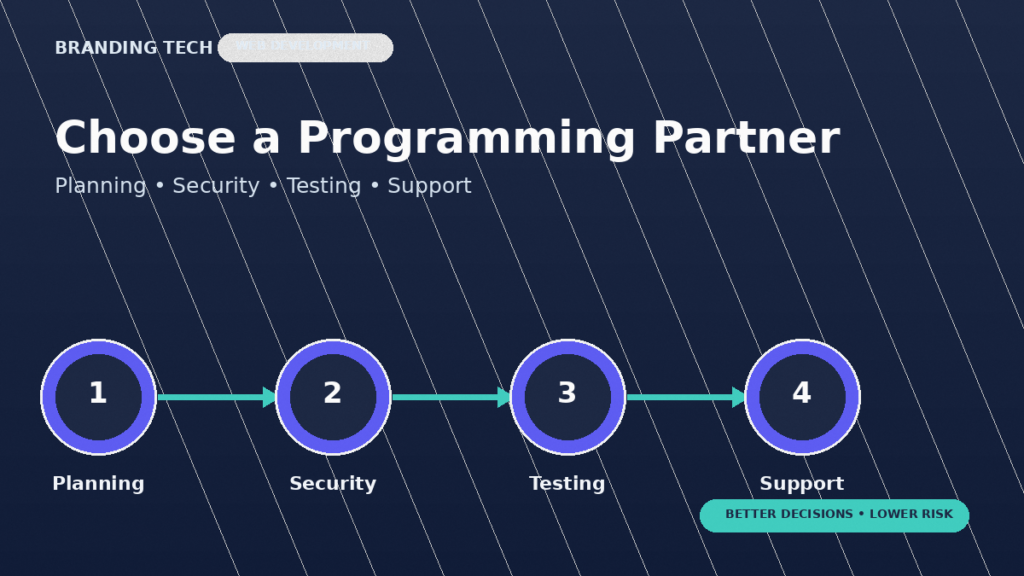
What to check when choosing a web programming partner.
Branding Tech supports website strategy, design, content, SEO, digital advertising, and AI automation. We can help clarify the customer journey and identify where a standard website, integration, or automation is sufficient.
For advanced custom platforms, complex databases, or large enterprise systems, a specialist development company may be required. The project should use the right team for each part rather than asking one provider to pretend it covers every technical area.
Web design focuses on layout and user experience. Web programming creates the functions, data handling, user roles, calculations, and system connections behind the interface.
Use a ready-made tool when it meets the main requirements and offers suitable ownership, cost, and support. Choose custom development when the business process creates a real need.
Timing depends on scope, integrations, data, design, testing, and approvals. A small tool may take weeks, while a complex platform may take many months.
The provider should monitor errors, support users, maintain security, create backups, update dependencies, and plan future improvements.
The right web programming company should ask how the business works before discussing code. It should plan users, data, security, testing, ownership, and support clearly.
Start with one valuable workflow. Build and test in stages, involve real users, and keep control of your accounts and data. Good web programming makes a business process easier, not more complicated.
Choosing the right IT company in Kuala Lumpur makes daily work easier. The right team fixes problems, protects data, and supports growth. A poor choice wastes time and budget.
Kuala Lumpur has many technology providers. Some support office systems. Others build websites, software, cloud tools, or automation. Define your needs before asking for a price.
This guide explains key IT services in simple, practical language. It shows what to check, what to ask, and how to choose a reliable partner in Malaysia.

IT company in Kuala Lumpur for practical business support.
Most businesses depend on email, cloud storage, accounting tools, websites, payment systems, and customer databases. When one system fails, work may slow down or stop.
A reliable IT partner prevents problems, improves old systems, and reduces manual work. This gives staff more time to serve customers and support long term business goals.
A Kuala Lumpur team understands Malaysian customers, local payment methods, and common business needs. It can meet your staff when closer discussion is needed. MDEC provides guidance for businesses that adopt digital tools.
An IT company helps businesses use technology in a safe and useful way. The service depends on the company and its main area of work.
Common services include:
Some providers focus on office systems. Others focus on software, websites, or online customer journeys.
Start with your business problem, not with a long list of services. This will help you find the right type of partner.
Before you contact a provider, decide which area needs help.
Choose an IT support company in Kuala Lumpur when your team needs help with devices, email, Wi-Fi, software, or backups. Ask about support hours, response times, and on-site visits.
Cloud tools support online work and file sharing. Ask about two-step login, backups, access, and recovery. Choose a provider with cybersecurity experience when risks are higher.
A software development company in Kuala Lumpur can build a booking system, portal, app, or dashboard. Confirm who owns the code and data, how testing works, and what support follows launch.
An IT solutions company in Kuala Lumpur may combine website work with SEO, advertising, customer tools, and automation.
For wider projects, you may need a digital transformation company in Kuala Lumpur. A system may look cutting edge, but it must solve a real business problem.
Do not choose a provider only because its website looks professional. Check its process, support, and relevant results.
A good provider asks about your goals, staff, tools, budget, and problems. Avoid any company that recommends a package before understanding your needs.
Relevant experience matters more than a long service list. Review similar projects and look for clear results, not only attractive screenshots.
The proposal should show what is included and excluded. Check the timeline, price, payment stages, extra fees, and work needed from your team.
Your business should control its domain, hosting, cloud account, website, data, and advertising accounts. Give the provider the access it needs, but keep the main ownership.
Ask how the team protects private data and admin accounts. Also ask how often it creates backups and how it will restore your system after a problem.
The team must explain its work clearly. Ask who will manage your account, where to send requests, and when you will receive updates. For managed IT services in Kuala Lumpur, confirm the response times.
Use measures that match the service. You may track response time, solved issues, website enquiries, sales, page speed, or time saved. A useful report shows results, not only tasks.
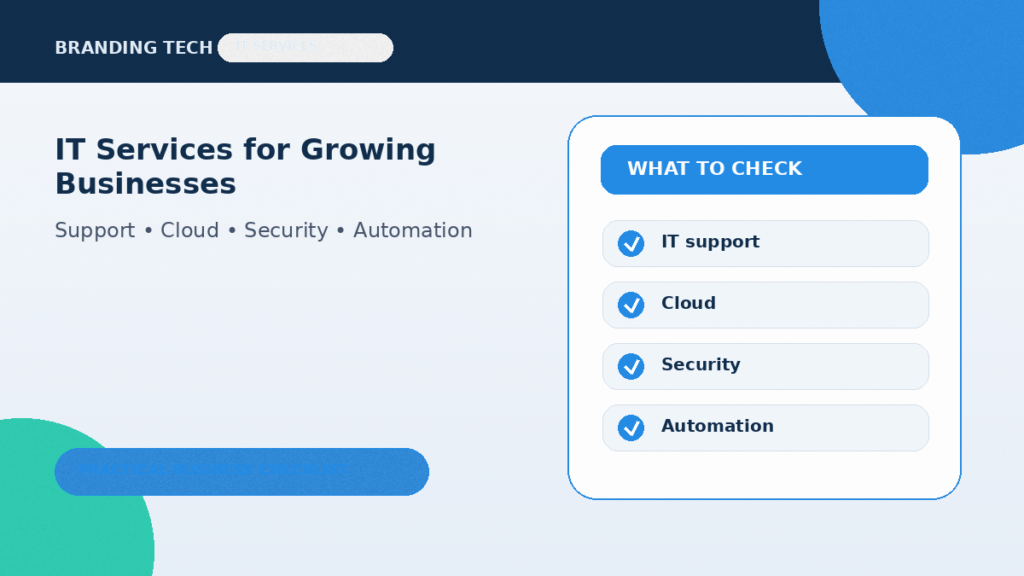
IT services that support growing businesses in Kuala Lumpur.
Use these questions when you compare providers:
The answers should be direct and easy to understand. Be careful with unclear promises or pressure to sign quickly.
A local IT company in Kuala Lumpur can meet your team in person. It may also understand Malaysian customers and local business needs.
A remote provider can still handle websites, cloud support, software, and automation. A mixed approach may work best, with online support and office visits when needed.
There is no single price for IT services. The cost depends on the work, number of users, level of risk, and support hours.
A small website will not cost the same as a custom system. Ask each provider to separate setup fees, monthly fees, licences, maintenance, and optional work.
Do not choose only by price. A very low price may leave out testing, security, training, or support. Compare all providers using the same list of needs.
Do not buy a tool before you understand the problem. A new system cannot fix an unclear work process by itself.
Keep control of important accounts and give the provider only the access it needs. Also, do not choose a team only because it offers many services.
Start with the most important problem. Test the result before you add more work.
Follow these steps when you compare an IT company in Kuala Lumpur:
This process makes comparison easier and helps the chosen provider plan the work.

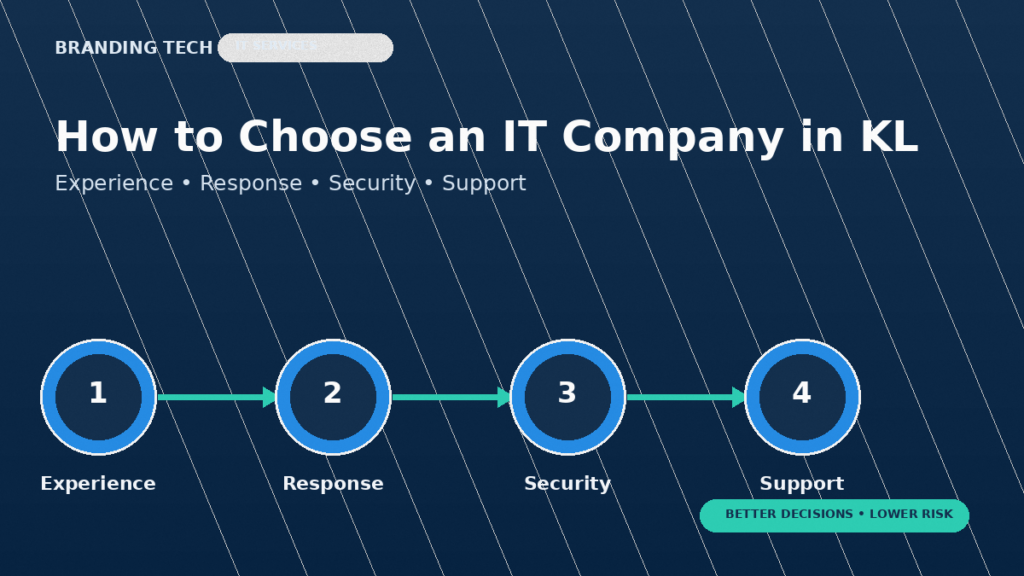
A simple checklist for choosing an IT company in KL.
Branding Tech connects technology with online growth. We provide websites, SEO, paid advertising, branding, content, and AI automation. We help businesses attract customers, manage leads, and reduce repeated work.
We are not a hardware repair or network support centre. For device repair or full-time server monitoring, choose a specialist provider.
If you need a stronger website, better search visibility, more leads, or smarter customer follow-up, Branding Tech can help. We can review your needs and suggest a clear digital plan for your business.
Services may include IT support, cloud tools, online security, software, websites, system connections, data reports, and automation. Each company has different strengths, so check its main experience.
Start with the problem you need to solve. Then compare experience, service scope, price, security, support, communication, and account ownership.
An IT company often focuses on systems, networks, cloud tools, security, and software. A digital agency focuses on websites, content, advertising, and online sales. Some providers offer services from both areas.
Yes. Branding Tech can help connect websites, lead forms, customer messages, and marketing tools. The goal is to save time and improve customer follow-up.
The best IT company in Kuala Lumpur is not always the biggest or cheapest company. It is the company that understands your goal and gives you a clear plan.
Look for a team that uses simple language, protects your accounts, and explains every cost. Make sure the team offers the right support after the work is complete.
If your goal is to improve your website, online visibility, customer leads, or business automation, speak with Branding Tech. We can help you choose a practical solution for your business in Kuala Lumpur, Selangor, or other parts of Malaysia.
A website is often the first place where customers judge a business. They use it to understand services, compare options, check trust, and decide whether to contact the company. Choosing the right web designer in KL can make this journey useful.
Good web design is not only about colours and images. It combines content, layout, mobile usability, speed, SEO, and a strong call to action. The designer should understand the customer and the business result you want.
This guide explains what a professional web designer should provide and how to compare your options.

Web designer KL for a clear and effective business website.
A web designer plans how the website looks and how visitors move through it. The work includes page layout, colours, fonts, images, buttons, forms, menus, and mobile presentation.
Some designers also build the website. Others prepare the design and work with a developer. A full project may also need copywriting, SEO, analytics, ecommerce, integrations, and maintenance.
Ask who will handle each part. A beautiful design is not enough if the website is difficult to use.
A “website designer Kuala Lumpur” provider may focus on layout and user experience. A “web design company KL” may provide design, development, content, and support. A “professional web designer KL” should explain the process and ownership clearly.
A “WordPress designer Kuala Lumpur” is useful for WordPress projects. “Affordable web design KL” can suit smaller websites, but the quotation must state what is included. “Website design services KL” should always match the business goal.
Before requesting a quotation, decide the main purpose of the site. It may need to generate leads, sell products, receive bookings, explain services, support recruitment, or build trust.
Choose one main action for each key page. This could be a form, WhatsApp message, phone call, purchase, booking, or download.
The goal helps the designer plan the page order and visual priority. Visitors should see the most important information first.
The homepage should quickly explain what the company offers, who it serves, and why customers should trust it. Avoid large sections that look impressive but say very little.
Many people in Kuala Lumpur will visit on a phone. Text, buttons, menus, forms, maps, and payment steps must work on small screens.
Large images, unnecessary effects, and poor development can slow a site. Speed affects user experience and may also affect search performance.
Visitors should find services, products, contact details, and important information without guessing. Use familiar labels and a logical page structure.
Useful proof may include client work, reviews, company details, team information, certifications, clear policies, or case studies. Only use proof that is accurate.
Tell visitors what to do next. Use direct labels such as “Request a quotation,” “Book a consultation,” or “WhatsApp us.”
A web designer focuses on presentation and user experience. A web developer handles technical functions and connections. An agency may provide both, together with content, SEO, branding, and marketing.
A freelance web designer in KL may suit a focused project. A wider agency may be better when the website needs several specialists or ongoing promotion.
For technical platforms, advanced features, or integrations, read the web developer Malaysia guide. It explains when development experience becomes especially important.

Good web design features for Kuala Lumpur businesses.
Do not rely only on screenshots. Open completed websites on mobile and desktop. Check the message, navigation, forms, speed, and overall experience.
Ask what the designer personally completed and whether the website is still supported by the same team.
A good designer asks about the audience, services, competitors, goals, content, brand, and current problems. The first discussion should focus on the business before visual preferences.
The proposal should state pages, design approach, content responsibilities, features, revisions, SEO setup, testing, training, timeline, hosting, and maintenance.
Confirm exclusions and extra costs. Stock images, paid fonts, plugins, product uploads, translations, and copywriting may not be included.
Your business should control the domain, hosting, website account, analytics, and related tools. Ask who owns the final design, content, and custom work.
Ask what happens after launch. A warranty period may cover bugs, while maintenance covers updates, backups, security, and future changes.
Design depends on content. If the message is not ready, the designer may build attractive empty sections that do not help customers.
Prepare the services, customer problems, benefits, process, proof, FAQs, and call to action. A copywriter can help when your team does not have time or experience.
Basic SEO should be part of the structure. Important services need useful pages, clear titles, one H1, logical headings, readable URLs, internal links, and helpful content.
Do not repeat a keyword in every paragraph. Natural language is easier for customers and search engines to understand.
After launch, the website marketing Malaysia guide can help you plan SEO, advertising, content, and conversion tracking.
Prices vary because projects are different. Cost depends on pages, custom design, content, languages, ecommerce, booking, integrations, animation, SEO, and support.
A template-based company website normally costs less than a custom site. An online store or portal costs more because it needs additional functions and testing.
Ask for one-time and recurring costs. Recurring expenses may include domain, hosting, software licences, maintenance, and support.
Compare what is included. A low price may not include content, mobile testing, SEO, security, or training.
One mistake is copying another website without understanding why it works. Your site should fit your own customers, offer, and brand.
Another mistake is adding too many effects. Movement and animation should guide attention, not slow the page or distract from the message.
Some companies hide important contact details or use long forms. Make action simple, especially on mobile.
Finally, do not allow the website to become outdated. Assign responsibility for content, security updates, backups, and performance.
Kuala Lumpur businesses may serve local residents, tourists, expatriates, and customers across Malaysia. Choose language and content based on the main audience.
Use familiar payment, contact, and location information where relevant. Make phone numbers, WhatsApp, maps, operating hours, and service areas easy to find.
The MDEC Business Digitalisation Initiative encourages businesses to adopt suitable digital tools. A website supports digital growth when it makes the customer journey easier and gives the company useful data.
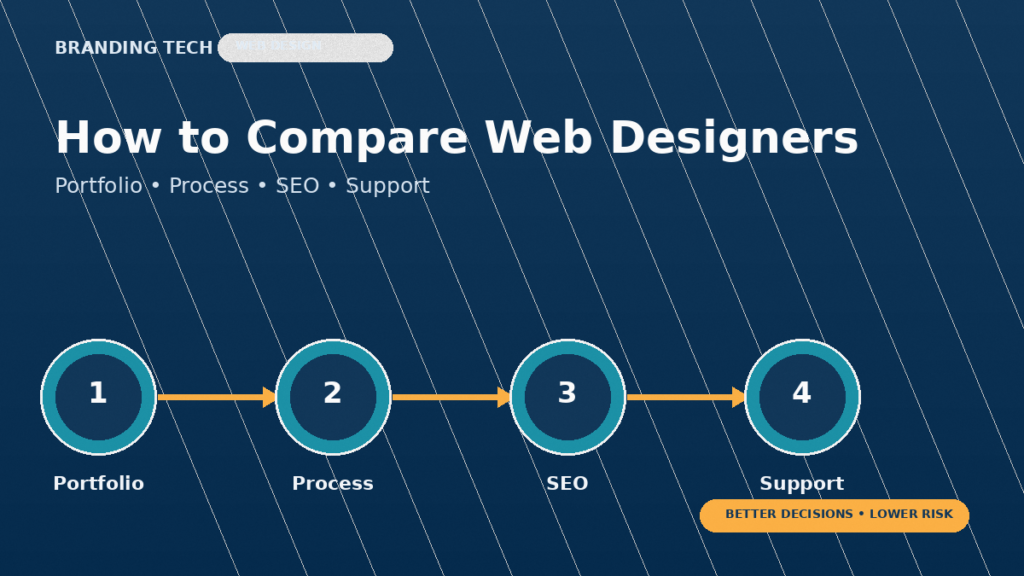
How to compare web designers in Kuala Lumpur.
Branding Tech provides website design, content, SEO, branding, advertising, and automation. We plan the website as part of the full customer journey.
We help businesses organise pages, clarify the message, build responsive layouts, track enquiries, and prepare for future marketing.
If your main need is broader branding and creative work, the design company in Malaysia guide explains how to compare agencies beyond website design.
A small website may take a few weeks. Larger projects take longer because of content, custom design, features, products, languages, testing, and approvals.
Some can provide basic or advanced SEO, while others focus only on design. Ask exactly what keyword planning, content, technical setup, and ongoing work are included.
A template can reduce cost and time for a simple website. Custom design is useful when the brand, customer journey, or functions need a more specific solution.
Most modern systems allow trained staff to update common content. Ask for administrator access, documentation, and training before the project ends.
The right web designer in KL should make your message clearer and the customer journey easier. The provider should explain the process, protect your account ownership, and deliver a site that works on mobile devices.
Start with the goal. Compare live work, scope, content, SEO, testing, communication, and support. A successful website is not only attractive. It helps the right customers take action.
Choosing the right IT company in Kuala Lumpur makes daily work easier. The right team fixes problems, protects data, and supports growth. A poor choice wastes time and budget.
Kuala Lumpur has many technology providers. Some support office systems. Others build websites, software, cloud tools, or automation. Define your needs before asking for a price.
This guide explains key IT services in simple, practical language. It shows what to check, what to ask, and how to choose a reliable partner in Malaysia.

IT company in Kuala Lumpur for practical business support.
Most businesses depend on email, cloud storage, accounting tools, websites, payment systems, and customer databases. When one system fails, work may slow down or stop.
A reliable IT partner prevents problems, improves old systems, and reduces manual work. This gives staff more time to serve customers and support long term business goals.
A Kuala Lumpur team understands Malaysian customers, local payment methods, and common business needs. It can meet your staff when closer discussion is needed. MDEC provides guidance for businesses that adopt digital tools.
IT company in Kuala Lumpur for practical business support.
An IT company helps businesses use technology in a safe and useful way. The service depends on the company and its main area of work.
Common services include:
Some providers focus on office systems. Others focus on software, websites, or online customer journeys.
Start with your business problem, not with a long list of services. This will help you find the right type of partner.
Before you contact a provider, decide which area needs help.
Choose an IT support company in Kuala Lumpur when your team needs help with devices, email, Wi-Fi, software, or backups. Ask about support hours, response times, and on-site visits.
Cloud tools support online work and file sharing. Ask about two-step login, backups, access, and recovery. Choose a provider with cybersecurity experience when risks are higher.
A software development company in Kuala Lumpur can build a booking system, portal, app, or dashboard. Confirm who owns the code and data, how testing works, and what support follows launch.
An IT solutions company in Kuala Lumpur may combine website work with SEO, advertising, customer tools, and automation.
For wider projects, you may need a digital transformation company in Kuala Lumpur. A system may look cutting edge, but it must solve a real business problem.
Do not choose a provider only because its website looks professional. Check its process, support, and relevant results.
A good provider asks about your goals, staff, tools, budget, and problems. Avoid any company that recommends a package before understanding your needs.
Relevant experience matters more than a long service list. Review similar projects and look for clear results, not only attractive screenshots.
The proposal should show what is included and excluded. Check the timeline, price, payment stages, extra fees, and work needed from your team.
Your business should control its domain, hosting, cloud account, website, data, and advertising accounts. Give the provider the access it needs, but keep the main ownership.
Ask how the team protects private data and admin accounts. Also ask how often it creates backups and how it will restore your system after a problem.
The team must explain its work clearly. Ask who will manage your account, where to send requests, and when you will receive updates. For managed IT services in Kuala Lumpur, confirm the response times.
Use measures that match the service. You may track response time, solved issues, website enquiries, sales, page speed, or time saved. A useful report shows results, not only tasks.
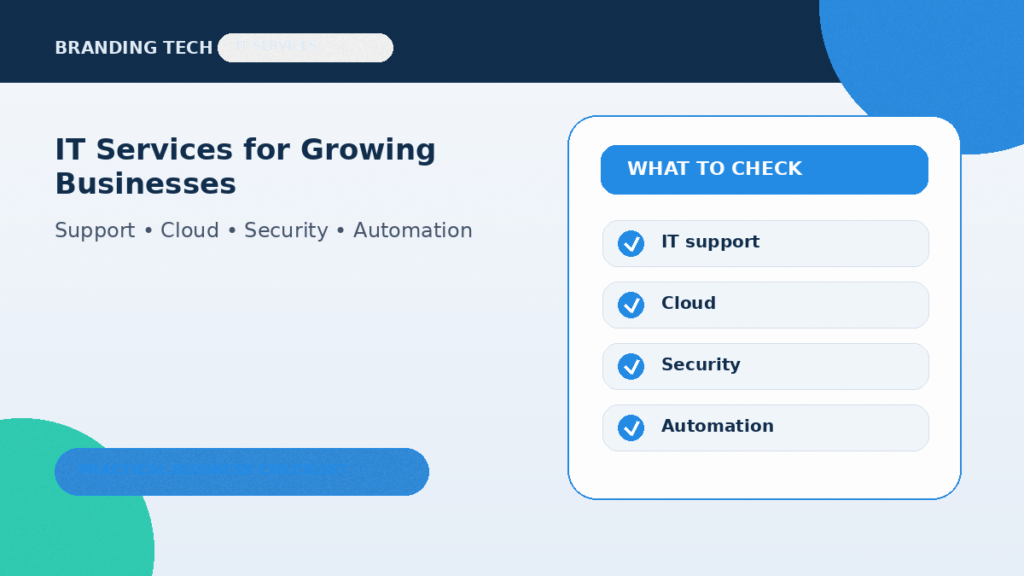
IT services that support growing businesses in Kuala Lumpur.
Use these questions when you compare providers:
The answers should be direct and easy to understand. Be careful with unclear promises or pressure to sign quickly.
A local IT company in Kuala Lumpur can meet your team in person. It may also understand Malaysian customers and local business needs.
A remote provider can still handle websites, cloud support, software, and automation. A mixed approach may work best, with online support and office visits when needed.
There is no single price for IT services. The cost depends on the work, number of users, level of risk, and support hours.
A small website will not cost the same as a custom system. Ask each provider to separate setup fees, monthly fees, licences, maintenance, and optional work.
Do not choose only by price. A very low price may leave out testing, security, training, or support. Compare all providers using the same list of needs.
Do not buy a tool before you understand the problem. A new system cannot fix an unclear work process by itself.
Keep control of important accounts and give the provider only the access it needs. Also, do not choose a team only because it offers many services.
Start with the most important problem. Test the result before you add more work.
Follow these steps when you compare an IT company in Kuala Lumpur:
This process makes comparison easier and helps the chosen provider plan the work.

A simple checklist for choosing an IT company in KL.
Branding Tech connects technology with online growth. We provide websites, SEO, paid advertising, branding, content, and AI automation. We help businesses attract customers, manage leads, and reduce repeated work.
We are not a hardware repair or network support centre. For device repair or full-time server monitoring, choose a specialist provider.
If you need a stronger website, better search visibility, more leads, or smarter customer follow-up, Branding Tech can help. We can review your needs and suggest a clear digital plan for your business.

A simple checklist for choosing an IT company in KL.
Services may include IT support, cloud tools, online security, software, websites, system connections, data reports, and automation. Each company has different strengths, so check its main experience.
Start with the problem you need to solve. Then compare experience, service scope, price, security, support, communication, and account ownership.
An IT company often focuses on systems, networks, cloud tools, security, and software. A digital agency focuses on websites, content, advertising, and online sales. Some providers offer services from both areas.
Yes. Branding Tech can help connect websites, lead forms, customer messages, and marketing tools. The goal is to save time and improve customer follow-up.
The best IT company in Kuala Lumpur is not always the biggest or cheapest company. It is the company that understands your goal and gives you a clear plan.
Look for a team that uses simple language, protects your accounts, and explains every cost. Make sure the team offers the right support after the work is complete.
If your goal is to improve your website, online visibility, customer leads, or business automation, speak with Branding Tech. We can help you choose a practical solution for your business in Kuala Lumpur, Selangor, or other parts of Malaysia.
Hiring a freelance web designer in KL can be a practical choice for a small or clearly defined project. A freelancer may offer direct communication, flexible working arrangements, and a lower starting price. However, some websites need a wider team with content, development, SEO, security, and ongoing support.
The right choice depends on the project, not only the budget. A simple landing page is different from an ecommerce store, membership portal, or multilingual corporate website.
This guide explains when a freelancer is suitable, when an agency may be safer, and what to check before you hire either option.
Freelance web designer KL for suitable website projects.
Write down the purpose of the website. Do you need more enquiries, online sales, bookings, information, or a professional company profile?
List the pages and features you expect. These may include forms, WhatsApp, maps, payments, products, booking, multiple languages, blog posts, or connections with other systems.
Also decide who will prepare the content, images, and approvals. Many website delays happen because these responsibilities are unclear.
When the project is defined, you can judge whether one person has the time and skills to complete it safely.
A “freelance website designer Kuala Lumpur” provider may focus on layout and user experience. A “freelance web developer KL” handles more technical work. An “affordable web designer KL” can suit a simple project, but the scope still matters.
A “WordPress freelancer Kuala Lumpur” specialises in WordPress. A “website freelancer Malaysia” may work remotely across locations. For online stores, a “freelance ecommerce developer KL” should understand products, payments, shipping, security, and support.
A freelancer can be suitable when the project is small, the requirements are stable, and one person can handle most of the work.
Examples include a simple landing page, a small company website, design improvements, page updates, or regular content changes.
The key is relevant experience and availability.
An agency is useful when the project needs several connected skills. A larger website may require content, design, development, SEO, and automation.
An agency can divide work between specialists and provide a project manager. It may also offer stronger continuity if one team member becomes unavailable.
Choose an agency when the website affects important sales, customer data, payments, or several departments. The extra structure may reduce risk.
Our web designer KL guide explains how to compare professional providers based on process, ownership, and results.
Some freelancers have deep experience and can manage complex work. Some agencies have limited in-house skills and outsource most tasks. Do not assume quality from the title alone.
Ask who will complete design, development, content, SEO, testing, and support. Review live websites and open them on a phone.
Check whether the pages are easy to understand, load properly, and guide visitors toward a clear action. Attractive screenshots do not prove that the full website works well.
A clear quotation should explain:
Compare several proposals using the same requirements. A cheap package may exclude important work, while a higher price may include content, SEO, testing, and support.
Your business should control the domain, hosting, website administrator account, analytics, and other important services.
The designer can receive access needed to work, but the accounts should not remain under a personal name that you cannot control.
Ask who owns the design, content, source files, and custom code after payment. Record paid themes, plugins, fonts, and image licences.
If the relationship ends, you should be able to move the website or appoint another provider without losing access.
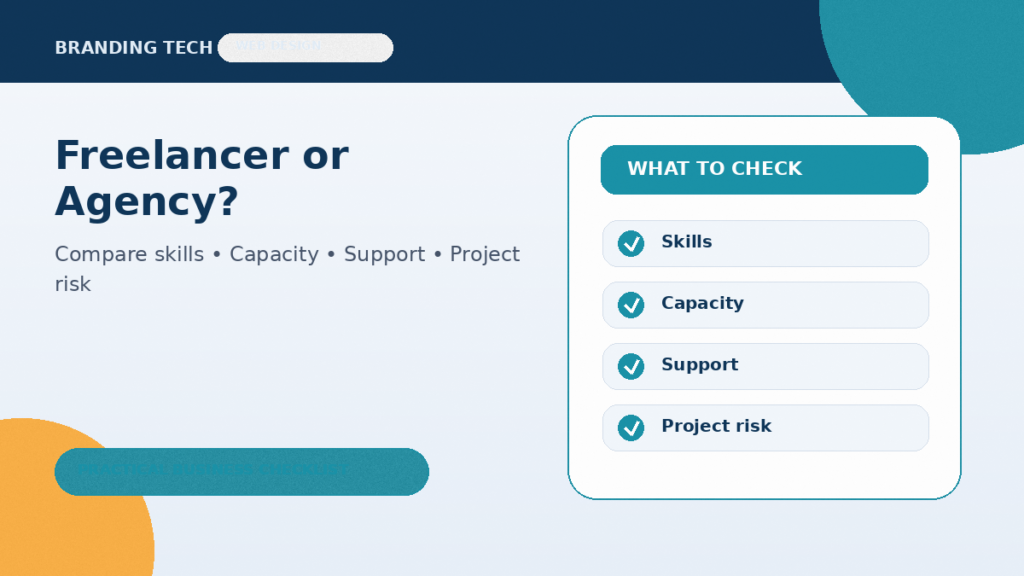
Compare a freelance web designer with a web design agency.
A freelancer may manage several projects at once. Ask how quickly messages are answered, what happens during leave, and how urgent problems are handled.
For an agency, ask who your contact person is and whether support is handled by the same team that built the website.
Agree on a warranty period for bugs. Then discuss ongoing maintenance for backups, security updates, software updates, small changes, and technical help.
A website is not a one-time poster. It needs care after launch.
Web design focuses on layout, visual style, and user experience. Development makes features work. SEO helps search engines understand and find the pages. Content explains the offer and answers customer questions.
One person may provide several skills, but you should confirm this with examples. If advanced programming or system connections are required, a web programming company may be a better fit.
If you want to build the site yourself, the website builder Malaysia guide explains the benefits and limits of common platforms.
A KL-based freelancer may understand local customers, business areas, languages, and common communication channels such as WhatsApp. In-person meetings may also be easier.
However, location alone does not guarantee quality. A remote Malaysian professional may deliver excellent work with a clear online process.
Choose the person or team that understands your audience and can support the project after launch.
Cost depends on pages, design, content, features, ecommerce, languages, integrations, and support. A small template-based website usually costs less than a custom design or online store.
Ask for one-time and recurring costs. Recurring expenses may include domain renewal, hosting, paid software, maintenance, and support.
Do not compare only the final number. Compare what you receive, the quality of the process, account ownership, and the risk if something goes wrong.
Be careful when a provider cannot explain the scope or timeline. Avoid paying the full amount before clear stages are completed.
Do not accept a website that will remain under the provider’s personal accounts. Also be cautious when the designer promises top Google rankings without reviewing the market and website.
Another warning sign is no testing or support plan. Forms, mobile pages, links, and tracking should be tested before launch.
Clear communication is essential. If simple questions are difficult before payment, support may be harder later.
Website ownership and support points to confirm before starting.
Branding Tech provides website design, content, SEO, branding, advertising, and AI automation. Our team connects the website with the customer journey and marketing goals.
We may be a suitable choice when the project needs more than one skill or when the business wants ongoing support after launch.
The MDEC Business Digitalisation Initiative encourages Malaysian businesses to assess their digital needs and choose suitable tools. We follow the same practical idea: begin with the business goal and build only what creates value.
Often, but not always. Compare the full scope, experience, support, software costs, and risk. An agency may include services that a freelancer prices separately.
Yes, if the freelancer has strong ecommerce experience and can support payments, delivery, security, testing, and maintenance. Review live stores before deciding.
Your business should own and control both. Give the designer suitable access without losing ownership of the account.
Ask this before the project starts. Keep administrator access, backups, licences, source files, and documentation so another professional can continue the work.
A freelance web designer in KL can be an excellent choice for a focused project with clear requirements. An agency may be safer when the work needs several skills, stronger project management, or long-term support.
Define the website goal first. Then compare real experience, scope, ownership, communication, testing, and support. The right provider should make the project clearer and give your business control of its digital assets.
Technology supports almost every part of a modern business. Email, cloud files, websites, customer systems, payments, and reporting must work reliably. Choosing the right IT company in Shah Alam can help your team solve problems, protect information, and use digital tools more effectively.
Different IT companies offer different services. Some focus on devices and office networks. Others build websites, software, cloud systems, or automation. The best provider is the one whose main experience matches your actual need.
This guide explains how to define that need, compare providers, and avoid common mistakes.
IT company in Shah Alam for reliable local technology support.
Do not begin with a long list of technology. Begin with what is not working.
Your staff may lose time because computers, email, or Wi-Fi fail. Customer information may be spread across several files. A website may not generate enough enquiries. Reports may take days to prepare. These are business problems that technology may help solve.
Write the problem, the people affected, and the result you want. This gives the IT provider useful information and makes quotations easier to compare.
“IT services Shah Alam” can cover networks, devices, cloud tools, and security. An “IT support company Shah Alam” usually handles daily problems. An “IT solutions company Shah Alam” may plan a wider business system.
“Managed IT services Shah Alam” means ongoing monitoring and maintenance. A “software company Shah Alam” may build or supply applications. A “technology company Shah Alam” can cover several areas. Always confirm the real service scope.
Support providers help with devices, email, networks, printers, user accounts, backups, and common software problems. Ask about support hours, response times, remote help, and office visits.
Cloud tools support file sharing, email, online work, backups, and access from different locations. The provider should plan permissions, security, migration, training, and recovery.
Security work may include account protection, access rules, backups, monitoring, staff awareness, and incident response. The level of protection should match the company’s data and risk.
Some IT companies build websites, online stores, portals, and booking systems. These projects may also need content, SEO, analytics, and marketing.
Custom software can support special workflows. Integration connects existing systems so information does not need to be copied manually.
Automation can move leads, send notifications, update records, or prepare reports. Begin with a clear repeated task and test the result before expanding.
A Shah Alam provider may visit your office when physical systems need attention. It may also understand local business areas, common service expectations, and the needs of Malaysian small and medium businesses.
Remote providers can support websites, software, cloud tools, and automation. Choose based on experience, communication, security, and support.
Businesses comparing a wider range of providers can read the IT company in Malaysia guide. Companies closer to Kuala Lumpur can also use the existing IT company in Kuala Lumpur guide.
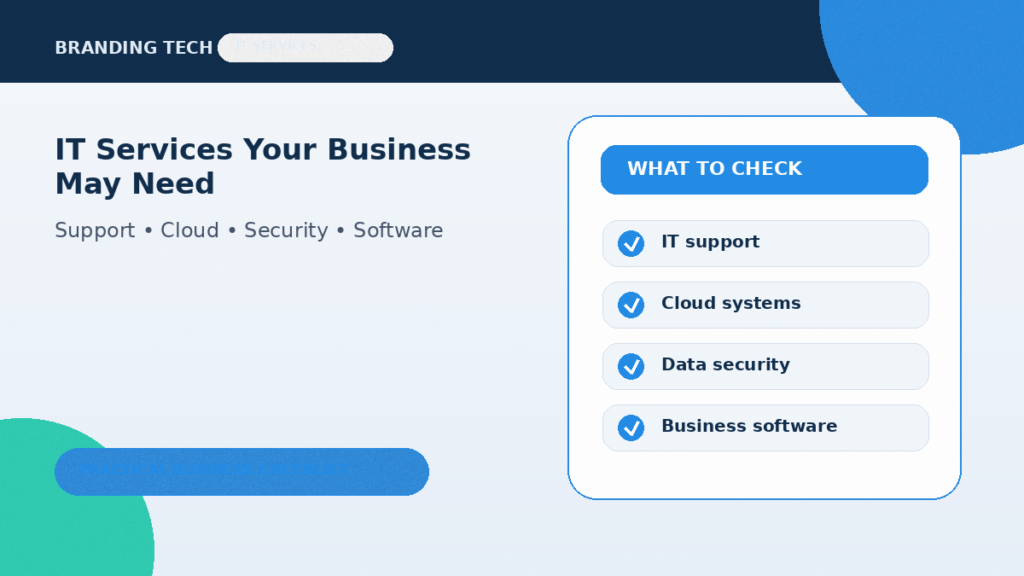
Common IT services for businesses in Shah Alam.
An excellent web team may not be the right company for office network support. A hardware support provider may not be the best choice for ecommerce or digital marketing.
Ask what type of work forms the largest part of the company’s business. Review projects related to your own need.
A good provider asks about users, systems, risks, budget, and goals. It should explain why a solution is suitable instead of recommending a standard package immediately.
For larger work, expect a discovery or assessment stage. This reduces unclear requirements later.
The proposal should show tasks, deliverables, timeline, responsibilities, exclusions, price, recurring fees, and support.
For support contracts, ask which devices and users are covered. For projects, confirm testing, training, data transfer, and launch support.
Your company should control its domain, hosting, cloud accounts, website, advertising accounts, data, and administrator credentials.
Give the provider the access required for work, but keep the main ownership with the business. Record who has access and remove old access when staff or suppliers change.
Discuss two-step login, permissions, backups, updates, monitoring, and recovery. Ask where data is stored and how the team responds to an incident.
Know who will manage your account and where staff should send requests. Define urgent and normal problems. Ask for realistic response and resolution targets.
Clear communication matters as much as technical skill. Staff should understand what is happening and what they need to do.
The right measures depend on the service. You may track system availability, response time, solved tickets, website enquiries, sales, page speed, time saved, or reduced errors.
IT costs depend on users, devices, service hours, project size, risk, integrations, and support level. A monthly support plan is different from a website or custom system project.
Do not choose only by price. A very low quotation may leave out security, testing, documentation, or support. Compare total value and risk.
One mistake is buying technology before improving the process. A new system cannot solve unclear responsibilities by itself.
Another mistake is allowing a supplier to own important accounts. This can create serious problems when the relationship ends.
Some companies also choose a provider with many services but little experience in the required area. Relevant proof is more useful than a long service menu.
Finally, businesses may ignore staff training. Even a good tool fails when users do not understand it or follow the agreed process.
The MDEC Business Digitalisation Initiative provides guidance for Malaysian businesses adopting digital solutions. Its practical message is important: assess the current situation and choose improvements that support productivity and competitiveness.
Start with one valuable problem. Test the change, measure the result, and expand when the business is ready.
Businesses searching for nearby software specialists can also use the software companies near me guide. It provides extra questions for comparing development and technical teams.
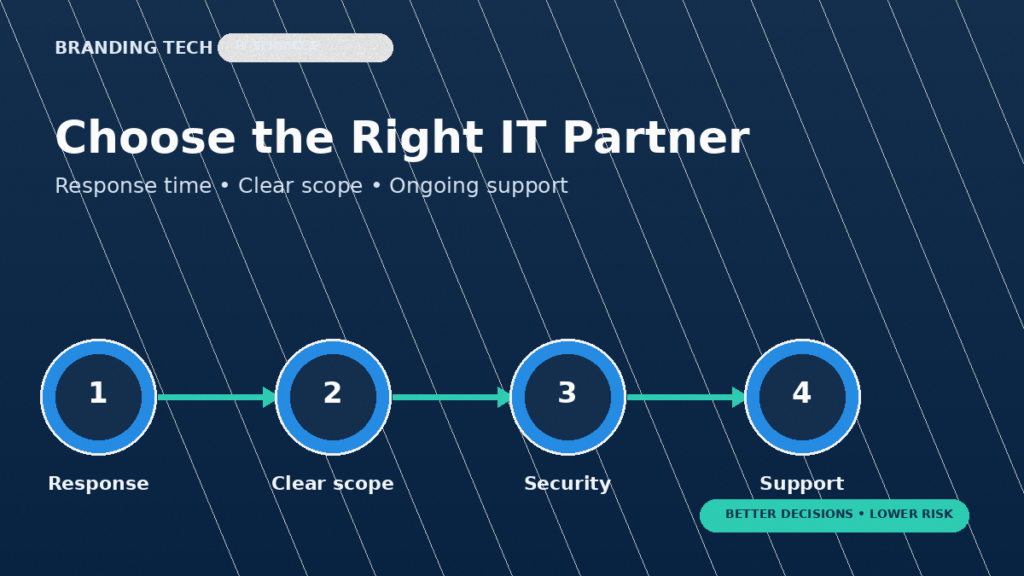
A simple checklist for choosing an IT partner in Shah Alam.
Branding Tech supports websites, SEO, digital advertising, branding, content, and AI automation. We help companies improve online visibility, lead collection, customer communication, and repeated marketing tasks.
We are not a hardware repair centre or full-time network monitoring provider. For device repair, complex servers, or specialist infrastructure, choose a provider with that exact experience.
If your Shah Alam business needs a stronger website, more qualified leads, or better digital follow-up, we can review the customer journey and recommend a practical plan.
Services may include technical support, cloud tools, security, websites, software, integrations, automation, and reporting. Check each provider’s main area of expertise.
A local team is helpful for office visits and physical systems. A remote team can still manage many cloud, website, software, and automation projects. Choose based on the service and support required.
Monthly support may help when staff regularly need technical assistance or when important systems require monitoring and maintenance. Compare covered users, hours, response times, and exclusions.
Use a clear agreement, keep ownership of accounts and data, limit access, require backups, confirm support terms, and plan how information will be returned if the relationship ends.
The right IT company in Shah Alam should understand the business problem and explain the solution clearly. It should protect your accounts, provide a complete scope, and offer suitable support.
Compare experience, process, communication, ownership, security, and results. The best partner is not always the biggest or cheapest. It is the one that can solve the right problem in a safe and practical way.