Choosing a software development company in Malaysia is an important business decision. Custom software can reduce repeated work, connect departments, improve reporting, and create a better customer experience. A poorly planned system can become expensive, difficult to use, and hard to maintain.
The first step is not choosing a programming language. It is understanding the business problem. A good development partner should ask how your team works today, where mistakes happen, and what result you want after the system is launched.
This guide explains when custom software is useful, how projects normally work, and what to check before signing a contract.
Software development company Malaysia for practical business systems.
Many companies begin with spreadsheets, messaging apps, and ready-made online tools. These options may work well at the start. Problems appear when data is repeated, staff follow different processes, or several tools do not communicate.
Custom software may help when your business needs a special booking flow, customer portal, operations dashboard, approval process, inventory system, mobile app, or connection between existing platforms.
It may also help when staff spend many hours copying information or preparing reports manually. The software should save time, reduce errors, or create new value. If it does not produce a clear benefit, a ready-made tool may be the better choice.
“Custom software development Malaysia” means building around a specific business process. A “software company Malaysia” search may show product sellers and custom developers. “Business software developer Malaysia” often focuses on internal systems.
An “application development company Malaysia” may build web or mobile apps. A “software solutions company Malaysia” can combine tools, integration, and support. “Enterprise software Malaysia” projects usually need stronger security, permissions, documentation, and maintenance.
A ready-made platform is usually faster and cheaper to start. It has common features, support, and regular updates. The business may need to adjust its process to fit the tool.
Custom software is designed around your requirements. It offers more control but needs a larger budget, clearer planning, testing, maintenance, and long-term technical support.
Before choosing custom development, review existing platforms. Sometimes a simple integration or automation can solve the problem without building a full system.
The MDEC Business Digitalisation Initiative encourages Malaysian businesses to assess their digital maturity and adopt suitable solutions. This is a useful principle: choose the level of technology that matches the problem and the company’s ability to manage it.
Software companies may provide different services. These can include:
Not every provider offers every service. Look for experience related to your project type and risk level.
You do not need to write a technical document before the first meeting. Start with the business situation.
Explain who will use the system, what they need to do, which information they need, and what problems they face today. List the existing tools that may need to connect with the new system.
Separate essential features from useful future features. This helps the provider plan a realistic first version. Large projects are often safer when divided into stages.
Also decide who inside your company will answer questions, review progress, and approve work. Software projects slow down when decisions are unclear.
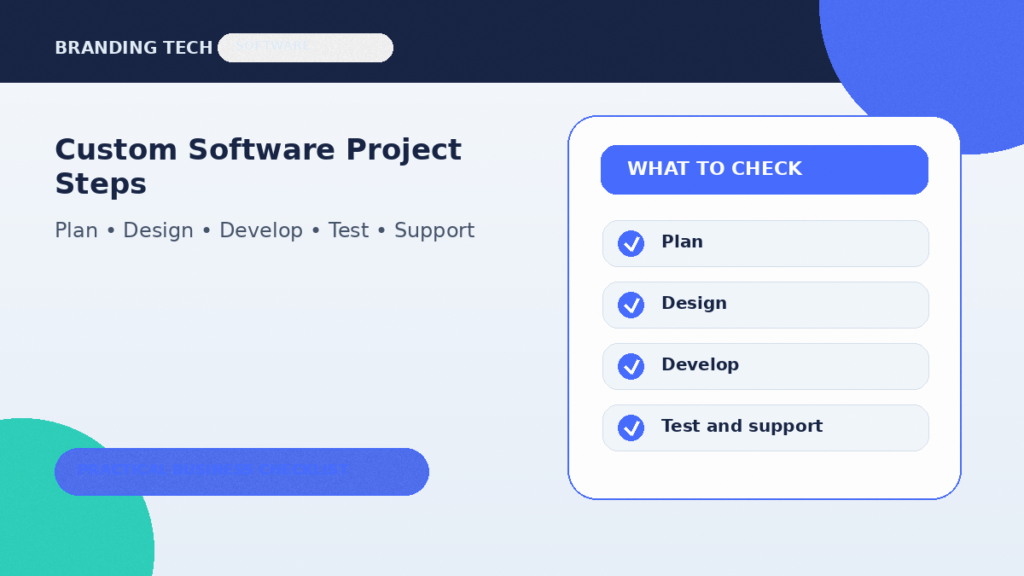
The main steps in a custom software development project.
The development team studies the business process, users, goals, data, risks, and integrations. It then prepares a scope, system plan, timeline, and budget.
The team plans screens, forms, menus, and user journeys. Simple prototypes help your staff review the flow before development becomes expensive to change.
Developers build the system in planned stages. Regular demonstrations allow the business to see progress and provide feedback.
Testing checks functions, permissions, calculations, integrations, performance, and mobile behaviour. Your own users should also test realistic tasks before approval.
The team prepares the live system, transfers data where required, trains users, and monitors early problems.
Software needs security updates, bug fixes, backups, monitoring, and improvements. The maintenance plan should be clear before launch.
Relevant experience matters more than a long technology list. Ask how the provider solved a similar problem.
Request a demonstration or case study where possible. Ask which parts its own team completed.
The company should explain technical decisions in clear language. Confirm who manages the project, how often you will receive updates, and how changes will be recorded.
Good communication is especially important when business staff and developers use different terms.
The proposal should show features, exclusions, stages, timeline, responsibilities, testing, training, data work, and support.
Ask how new requests will affect the cost and schedule. A written change process protects both sides.
Confirm who owns the source code, design, database, documentation, accounts, and intellectual property after payment. Your company should control production accounts and business data.
Ask whether the system uses licensed third-party components and what recurring costs apply.
Discuss user permissions, secure login, backups, data storage, testing, and incident response. The level of security should match the sensitivity of the information.
If the system handles personal or payment data, make sure the team understands the relevant responsibilities.
Cost depends on the number of users, features, integrations, data, security, design, testing, and support. A simple internal tool costs less than a customer platform with mobile apps and complex integrations.
Ask for costs by project stage. Separate discovery, design, development, data migration, hosting, licences, training, and maintenance.
Do not choose only by the lowest estimate. An unclear low quote may grow after work begins. A detailed scope makes comparison more reliable.
One mistake is trying to build every idea in the first version. Start with the most valuable workflow and prove it works. Future stages can add lower-priority features.
Another mistake is copying a bad manual process into software. Improve the process before automating it.
Companies also underestimate data quality. Old, incomplete, or duplicated data can delay the project. Plan who will clean and approve information.
Finally, do not treat launch as the end. Software needs an owner inside the business, user feedback, maintenance, and regular improvement.
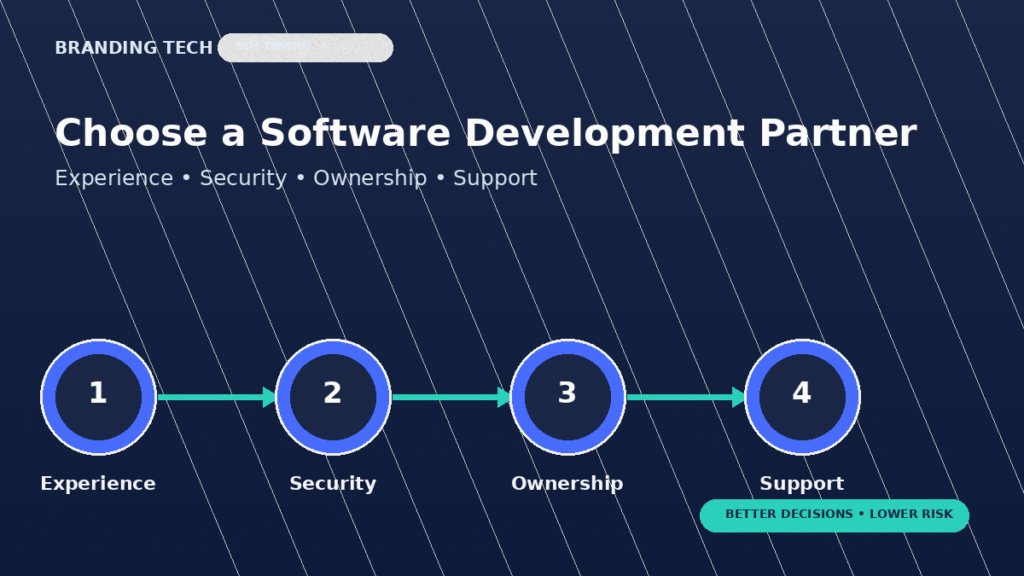
How to choose a software development partner in Malaysia.
Branding Tech focuses on websites, digital marketing, SEO, branding, content, and AI automation. We can help businesses improve customer journeys, connect lead forms and communication tools, and reduce repeated marketing or follow-up work.
For large custom systems, advanced mobile applications, or specialist enterprise software, a dedicated software development provider may be required. We can help clarify the digital goal and identify where website, automation, or specialist development fits.
Small systems may take several weeks, while complex platforms can take many months. The timeline depends on requirements, integrations, data, testing, feedback, and approvals.
Usually no. A focused first version reduces risk and allows real users to test the main process. Add more features after the core workflow is stable.
The contract should state ownership clearly. Your business should also control its data and important production accounts. Ask about third-party licences and reusable components.
Support may include monitoring, backups, bug fixes, security updates, user help, and planned improvements. Agree on response times and monthly or yearly costs.
The right software development company in Malaysia should understand your business before recommending technology. It should provide a clear process, realistic scope, careful testing, and dependable support.
Begin with one important problem. Protect ownership of your accounts and data, involve real users, and plan maintenance early. Custom software creates value when it makes work simpler, safer, and easier to measure.