Searching for “software companies near me” is a useful first step, but distance alone does not show whether a provider is suitable. The company must understand your business problem, have relevant technical experience, communicate clearly, and support the system after launch.
A nearby team can make meetings and office visits easier. A remote team may still deliver excellent software through a strong online process. The right choice depends on the project and the level of support required.
This guide explains how to turn a local search into a careful business decision.
Software companies near me selected by skill and support.
Software companies have different strengths. Some build mobile apps. Others create business systems, websites, ecommerce platforms, integrations, automation, or data dashboards.
Start with the problem. Explain what staff or customers do today, where delays or mistakes happen, and what result you want.
You may need a booking system, customer portal, inventory tool, approval workflow, reporting dashboard, mobile app, or connection between existing platforms.
The clearer the problem, the easier it is to find a company with matching experience.
Searching for “software developers near me” can show freelancers and full teams. A “custom software company near me” may be suitable for a system built around your own process. A “local app development company” usually focuses on mobile or web applications.
A “business software provider near me” may sell ready-made tools. “Software solutions near me” can include development, integration, support, and consulting. Review the actual scope because these labels are not used consistently.
A local software company can meet your users, observe office processes, and support work that requires physical access. This may help complex projects involving several departments.
A remote team can also run discovery meetings, design reviews, demonstrations, testing, and support online. It may offer specialist experience that is not available nearby.
Do not limit the search too early. First identify the skills and support you need. Then compare nearby and remote providers using the same requirements.
For Malaysian projects, the software development company Malaysia guide provides a wider comparison of development scope, ownership, and maintenance.
Search engines and Google Maps can show nearby providers. Professional networks, business associations, technology directories, and trusted referrals may also help.
Use specific searches. Add the project type, such as booking system developer, mobile app company, or CRM integration.
Create a shortlist based on relevant work. Some companies sell products rather than develop custom systems.
Ask for examples with similar users, workflows, integrations, or security needs. Industry experience can help, but problem-solving experience is often more important.
Ask what the company’s own team completed and whether it still supports the project.
A serious provider studies the process before building. It may interview users, map workflows, review data, prepare prototypes, and identify risks.
Be careful with a fast price for a complex system when the provider has not asked detailed questions.
The team should explain options in simple language. Confirm who manages the project, how often you will receive updates, and how decisions are recorded.
Good communication reduces expensive misunderstandings.
Ask who will maintain the system, fix problems, update security, manage backups, and support users after launch.
Know the support hours and response time. A nearby office does not guarantee fast support unless the agreement defines it.
A useful proposal should describe:
If important areas are missing, ask for clarification before signing.

How to review local software companies before requesting a quote.
Ownership must be clear. The contract should explain who owns custom code, design, database, documentation, and intellectual property after payment.
Your company should control the domain, production hosting, cloud services, and business data. The provider can receive access without becoming the only owner.
Ask about third-party libraries, licences, and services. Some components may remain under external terms.
Plan for transfer. If you change providers, you should receive current code, documentation, credentials, data, and deployment information.
The software team should plan user permissions, secure login, backups, updates, error logging, and recovery.
Ask how developers access production systems and how access is removed when someone leaves the project. Discuss where data is stored and which people can view it.
If the system handles personal, financial, health, or payment information, choose a provider with experience appropriate to that risk.
Security should be part of design and development, not an extra task added after launch.
Cost depends on features, users, data, integrations, design, platforms, security, testing, and support. Location is only one factor.
Local companies may have different rates from remote teams, but the cheapest rate does not always create the lowest total cost. Poor requirements or weak testing can lead to expensive rework.
Ask for a stage-based estimate. Separate discovery, design, development, migration, hosting, licences, training, and maintenance.
For unclear projects, begin with paid discovery. The output should give you a better scope and plan.
One mistake is choosing the closest company without checking relevant skills. The provider may not have experience with your project type.
Another mistake is sending a short message asking only for price. Give every shortlisted company the same brief so quotations are comparable.
Companies also forget to involve real users. Staff who perform the work should test the system before final approval.
Finally, do not ignore maintenance and transfer. Software remains valuable only when it can be supported safely over time.
Create a brief that explains the company, problem, users, essential features, integrations, data, budget range, and timeline.
Shortlist three to five providers with relevant work. Hold the same discussion with each one.
Score them on understanding, experience, process, communication, ownership, security, support, price, and risk.
Check references for larger projects. Ask past clients about communication, change management, testing, and post-launch support.
Choose the provider with the strongest overall fit, not simply the nearest address.
The MDEC Business Digitalisation Initiative encourages Malaysian companies to assess their digital maturity and adopt tools that improve productivity. This is a helpful approach when choosing software.
Begin with a process that creates measurable value. Test the result, train users, and improve the system in stages.
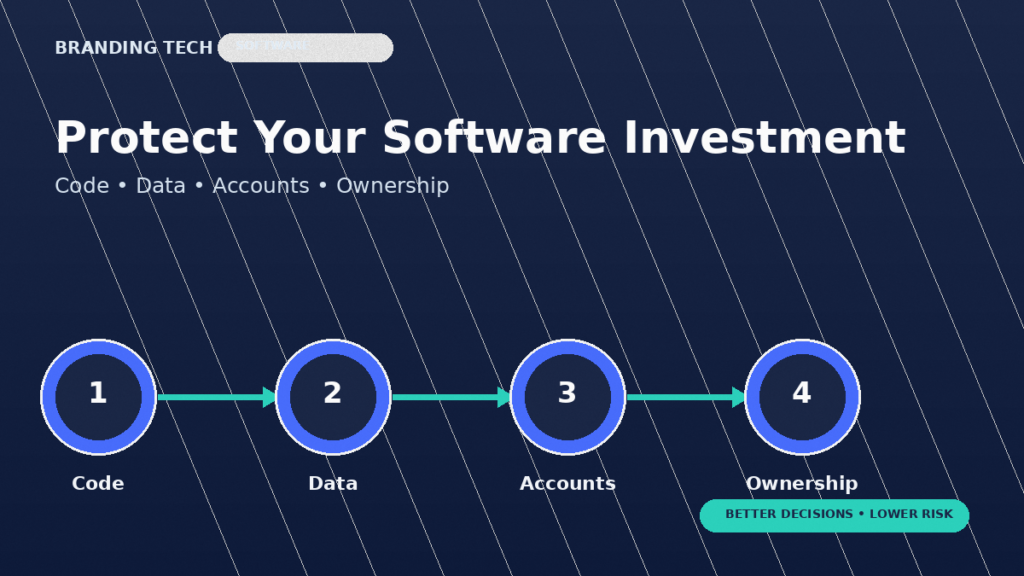
Protect code, data, and ownership in a software project.
Branding Tech supports websites, digital marketing, SEO, branding, content, and AI automation. We can help businesses improve online customer journeys and connect lead-generation or follow-up tools.
For advanced custom software, mobile applications, or enterprise systems, choose a dedicated provider with proven development experience. Our role can focus on the website, marketing, customer communication, or automation parts that match our scope.
No. Local access can help meetings and on-site support, but relevant experience, process, security, communication, and maintenance are more important.
Three to five serious providers are usually enough. Give them the same brief and compare the full proposal, not only the price.
A fixed price can work when requirements are clear. For uncertain projects, begin with discovery and use a staged estimate or controlled change process.
The contract should define ownership of code, design, data, documentation, and accounts. Your company should control its production systems and business information.
“Software companies near me” can help you find options, but it should not make the final decision. A suitable partner must understand the problem and support the full project journey.
Compare relevant experience, discovery, communication, security, ownership, testing, maintenance, and transfer. Choose the team that reduces risk and creates a system your business can use confidently.