A web developer turns a website plan into a working digital platform. The developer may build pages, forms, ecommerce functions, booking tools, portals, integrations, and performance improvements. Choosing the right web developer in Malaysia is important because the work affects security, speed, customer experience, and future maintenance.
Some projects need only a small business website. Others require custom programming and connections with several systems. The provider should match the complexity of the project.
This guide explains the main development options, the questions to ask, and the risks to avoid.
Web developer Malaysia for reliable business websites.
A web designer focuses on layout, visual style, and user experience. A web developer builds the technical structure and functions.
Ask who is responsible for each part. Clear roles help prevent gaps between the approved design and the working website.
The web designer KL guide gives more detail about visual design, content, and customer journeys.
A “website developer Malaysia” provider may build standard business websites. A “web development company Malaysia” usually offers a wider team. A “WordPress developer Malaysia” may be the right choice when WordPress is the selected platform.
A “professional web developer Malaysia” should explain security, testing, ownership, and maintenance. A “custom web developer Malaysia” builds special features. An “ecommerce web developer Malaysia” should understand products, checkout, payments, shipping, and integrations.
These sites explain services, build trust, and generate enquiries. Development may include content management, forms, mobile layouts, maps, analytics, and SEO setup.
Online stores need products, payments, delivery rules, stock, customer accounts, order emails, security, and testing.
Web applications perform business functions such as booking, customer access, approvals, calculations, dashboards, or workflow management.
Integration connects the website with payment, CRM, accounting, email, messaging, courier, or other tools. This can reduce manual work.
Developers may also improve speed, fix errors, update software, protect the site, manage backups, and add features.
A simple website may use WordPress or a hosted builder. These options can reduce development time and provide familiar content management.
A custom framework may be suitable when the project has special business rules, high integration needs, or a unique application.
Do not choose technology because it sounds modern. Ask how it fits the website goal, team skills, security, expected traffic, maintenance, and budget.
The website builder Malaysia guide explains when a standard platform may be enough. For advanced systems, the web programming company guide covers custom workflows and technical ownership.
Open completed websites and test them on mobile and desktop. Look at speed, navigation, forms, features, and the full customer journey.
Ask what the developer personally built. A portfolio may include design work completed by another company.
A good developer asks about users, pages, content, goals, features, integrations, data, and support. Technical work should support the business process.
For complex projects, expect a discovery stage before the final scope.
The proposal should list pages, functions, platform, content responsibilities, SEO setup, mobile testing, browser testing, security, tracking, training, timeline, and support.
Confirm exclusions. Product uploads, copywriting, paid plugins, translation, hosting, and third-party fees may be separate.
Know who manages the project and how often you will see progress. Regular demonstrations help identify misunderstandings before launch.
Ask how changes are requested, approved, and priced.
Your business should control the domain, hosting, website administrator account, analytics, payment account, and other important services.
The agreement should explain ownership of design, content, custom code, database, and documentation.

The difference between a web designer and web developer.
The website should adapt to common phones, tablets, and desktop screens. Important buttons and forms must remain easy to use.
The developer should optimise images, code, hosting, and other resources. Ask how performance will be tested.
The site needs secure connections, strong administrator access, updates, backups, and suitable protection for its data and functions.
Developers should support readable URLs, titles, headings, mobile performance, redirects, indexing, structured pages, and other technical SEO needs.
Text, colours, forms, labels, and navigation should be understandable for a wide range of users. Simple design often works better than unnecessary effects.
Test links, forms, emails, payments, calculations, user roles, integrations, and error messages. Your own team should test realistic tasks before approval.
Ask which parts your staff can update. Common tasks may include changing text, uploading images, publishing articles, adding products, and checking enquiries.
The developer should provide administrator access and basic training. Documentation is useful for repeated tasks and future staff.
Limit administrator access to people who need it. Create separate accounts instead of sharing one password.
Cost depends on pages, design, content, ecommerce, user roles, integrations, languages, custom functions, data, testing, and support.
A template-based company site usually costs less than a custom portal. An ecommerce project costs more because it needs payment, delivery, order management, and security.
Ask for setup and recurring costs. Recurring expenses may include domain, hosting, licences, applications, maintenance, and support.
Compare the complete scope. A low quote may exclude testing, content, SEO, security, or post-launch support.
The website needs monitoring, backups, software updates, security checks, and occasional improvements.
Ask whether the developer provides a warranty for bugs and a separate maintenance plan. Define how urgent issues are reported and how quickly the team responds.
Keep current backups and documentation. If you change providers, another developer should be able to understand and support the website.
One mistake is choosing a developer before defining the website goal. The project can grow without a clear priority.
Another mistake is starting development without content. Weak or late content changes the layout and causes delay.
Businesses also forget to protect ownership. Domains, hosting, and accounts should remain under company control.
Some sites launch without analytics or conversion tracking. This makes future marketing difficult to measure.
Finally, companies may stop communication after launch. Review website results, customer questions, errors, and improvement opportunities regularly.
The MDEC Business Digitalisation Initiative encourages Malaysian businesses to adopt tools that improve efficiency and competitiveness. A website supports this goal when it reduces friction for customers and staff.
If the business plans to sell online, the ecommerce web design Malaysia guide explains products, payments, delivery, and checkout. If the website needs promotion, continue to the website marketing Malaysia guide.
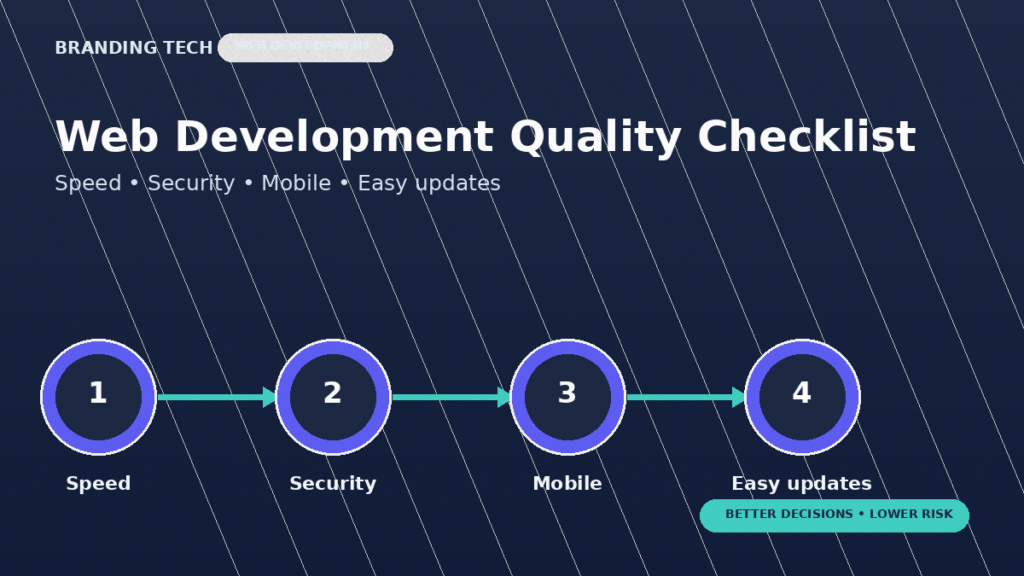
Technical quality points to check in web development.
Branding Tech provides website design and development, content, SEO, digital advertising, branding, and AI automation.
We plan websites around the customer journey and business goal. This includes clear pages, responsive design, lead tracking, and connections with marketing tools.
For specialist enterprise systems or complex software, we recommend using a development team with proven experience in that exact area. Honest scope creates better results than claiming every project is the same.
A small business website may take a few weeks. Ecommerce, multilingual, or custom projects take longer because of content, functions, integrations, testing, and approvals.
WordPress is suitable for many business and ecommerce sites. Custom development may be needed for special workflows or advanced integrations. Choose based on requirements and long-term support.
Some developers manage hosting, while others help you purchase it directly. Your business should understand the account, renewal, support, and backup arrangements.
Yes. Websites need backups, updates, security, error fixes, and content changes. Agree on responsibilities and response times before launch.
The right web developer in Malaysia should understand both the technical work and the business goal. It should provide clear scope, safe ownership, careful testing, and reliable support.
Compare relevant work, communication, technology, security, SEO, cost, and maintenance. A strong website should be easy for customers to use and practical for your team to manage.