A website builder can help a Malaysian business launch a simple site without starting from zero. Many platforms provide templates, page editors, hosting, and basic tools in one service. They can be useful, but they are not the best answer for every project.
The important question is not which builder is most popular. It is whether the platform can support your website goal, customer journey, staff skills, and future growth.
This guide explains when a website builder is suitable, when professional development may be safer, and what costs or limits to check.

Website builder Malaysia options for small businesses.
A website builder is a platform that lets users create pages through templates and visual editing tools. It may include hosting, security, forms, ecommerce, analytics, and applications.
Some builders are fully hosted. The platform manages the technical environment while you pay a monthly or yearly fee. WordPress is different because it can be installed with many hosting providers and extended with themes and plugins.
Each option offers a different balance of ease, control, flexibility, cost, and maintenance.
The “best website builder Malaysia” option depends on the project. An “easy website builder Malaysia” platform may suit a simple site. A “business website builder Malaysia” service should support professional pages, forms, analytics, and future updates.
An “ecommerce website builder Malaysia” platform must also handle products, payments, and shipping. A “WordPress website Malaysia” project offers flexibility but needs maintenance. An “affordable website platform Malaysia” should be judged by long-term cost, not only the first fee.
A builder may work well for a small company profile, personal site, simple landing page, event page, or early business test.
It is especially useful when requirements are standard, the budget is limited, and someone inside the company has time to manage content.
Templates can speed up design. Built-in tools may reduce the need for technical setup. The business can launch a basic site and improve it as it learns.
However, easy editing does not automatically create good content or a strong customer journey. The company still needs to plan the message, pages, calls to action, images, and search visibility.
Professional support may be safer when the website is important for sales, handles payments, needs several languages, contains many pages, or connects with other systems.
A professional team can help with strategy, content, design, development, SEO, analytics, testing, security, and maintenance.
Custom work may also be required for special booking, membership, quotation, portal, or workflow features. In these cases, the limits of a builder can create extra work later.
The web developer Malaysia and web programming company guides explain how to select technical support for more advanced projects.
Test how staff will update text, images, products, menus, and blog posts. A simple editor is useful only when the team can manage it consistently.
Templates should work on phones and tablets. Check buttons, forms, menus, product pages, and checkout on real devices.
The platform should allow page titles, meta descriptions, headings, readable URLs, image alt text, redirects, and search indexing controls.
Online stores need products, variations, stock, payment methods, delivery rules, discounts, order management, and customer communication.
Check whether the builder connects with analytics, advertising, CRM, email, booking, payment, and automation tools used by the business.
Understand what happens if you stop paying or want to move. Can you export content, products, customer data, and design? Some platforms make migration difficult.
Hosted builders manage much of the technical platform, but your company still manages content, settings, accounts, and applications. WordPress offers more control but needs regular updates and backups.
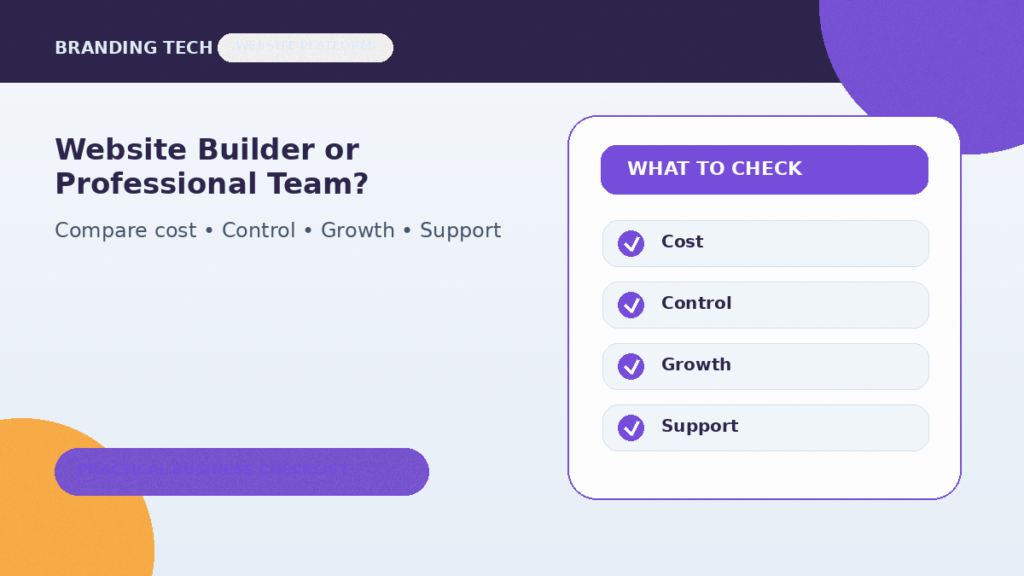
Compare a website builder with professional website development.
The visible subscription is only one cost. You may also pay for a domain, premium template, applications, ecommerce features, transaction fees, email, stock images, content, and professional setup.
Some platforms become more expensive as the business adds products, staff accounts, storage, or advanced features.
Compare costs over two or three years, not only the first promotional period. Include the time your staff will spend learning and maintaining the site.
Professional development has a higher setup cost but may provide a more suitable structure, stronger content, and better long-term support.
Many businesses choose a template and then struggle to fill its sections. Begin with the customer questions instead.
Explain what you offer, who it is for, what problem it solves, how the process works, why people should trust you, and what they should do next.
Plan the homepage, services or products, About page, contact page, FAQs, policies, and useful supporting content.
Use short paragraphs and clear headings. Do not add a section only because the template contains it.
A builder can support basic SEO, but the platform cannot replace strategy and useful content. Search visibility depends on page quality, technical performance, competition, local signals, authority, and ongoing work.
Use one main topic for each page. Avoid creating several pages that target nearly identical keywords. Connect related pages with helpful internal links.
Keep important business information consistent. For local companies, include the correct company name, location, phone number, hours, and service areas.
The website marketing Malaysia guide explains how SEO, advertising, content, and conversion tracking support a website after launch.
One mistake is choosing a platform before listing requirements. A builder may look easy during a trial but lack an important payment, language, or integration feature.
Another mistake is using a template without adapting it to the brand and audience. Generic pages can make the business look similar to competitors.
Businesses also add too many applications. Extra tools can increase costs, slow the website, or create security and compatibility problems.
Some users forget account ownership. Keep the domain, subscription, payment account, and administrator access under the business.
Finally, do not launch without testing. Check every form, email, button, link, map, payment, delivery rule, and mobile page.
Think about local payment methods, contact preferences, delivery, languages, and service areas. A Malaysian business may also need WhatsApp, Google Maps, local SEO, and suitable privacy information.
The MDEC Business Digitalisation Initiative encourages companies to assess their digital maturity before adopting tools. This is a useful approach for website builders. Choose a platform your staff can manage and your business can support.
If you are planning an online store, the ecommerce web design Malaysia guide explains payments, delivery, products, and checkout in greater detail.
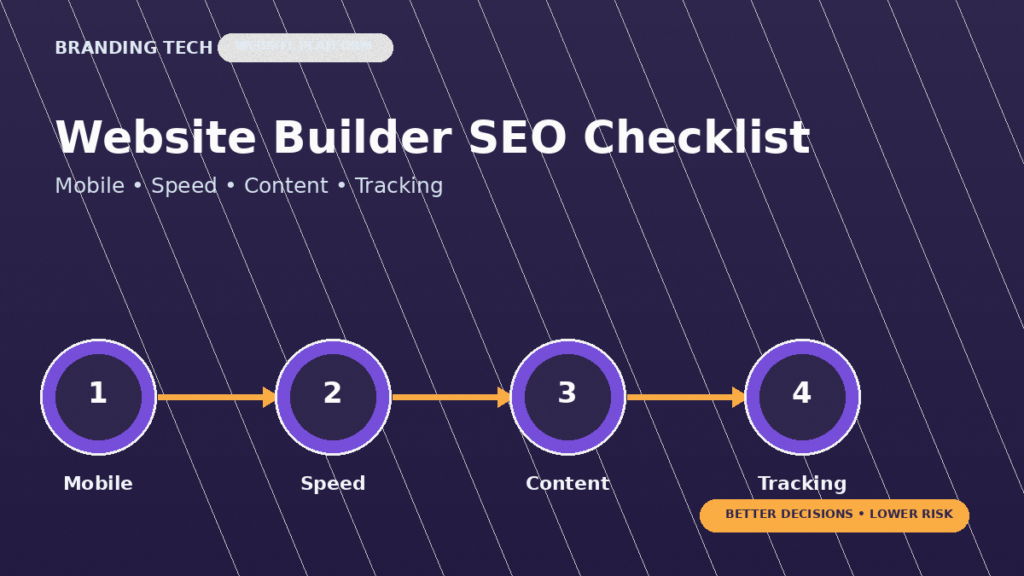
SEO features to check in a Malaysian website builder.
Branding Tech helps Malaysian businesses plan and build websites, create content, improve SEO, run digital advertising, and connect lead follow-up tools.
We can review whether a builder, WordPress website, ecommerce platform, or more custom solution fits the goal. The recommendation should consider both the launch and the work required after launch.
Our focus is a website that the business can own, understand, measure, and improve.
There is no single best platform. Compare your pages, ecommerce needs, payment options, languages, integrations, ownership, staff skills, recurring costs, and support.
Yes, especially for a simple site. Good results still require clear content, consistent branding, mobile testing, SEO setup, and regular maintenance.
WordPress is a content management system that can use visual page builders. It offers flexibility and ownership but needs suitable hosting, updates, security, and technical care.
It depends on the platform. Some allow content export but not full design or function transfer. Review portability before building a large site.
A website builder in Malaysia can be a smart option for a simple project with clear requirements. Professional design or development may be better when the website is central to sales, needs special features, or requires ongoing marketing.
Decide based on the full customer journey, ownership, long-term cost, staff capacity, and future needs. The easiest platform today is not always the easiest platform to grow with tomorrow.