An IT company can help a business operate more safely, serve customers better, and reduce repeated work. However, “IT services” covers many different areas. Choosing an IT company in Malaysia begins with understanding which type of support your business needs.
Some providers manage computers, networks, and cloud accounts. Others build software, websites, online stores, or automation. A provider may be excellent in one area and unsuitable in another.
This guide explains the main services, selection criteria, costs, and questions that Malaysian businesses should consider.
IT company in Malaysia for practical business technology support.
Write down the business problem before contacting providers. Staff may lose time because systems fail. Customer data may be spread across several tools. A website may not generate enough leads. Reports may be slow and unreliable.
Describe who is affected, how often the problem occurs, and what a better result would look like. This helps the IT company recommend a useful solution.
Avoid buying a tool only because it is popular or cutting edge. Technology should support a clear business goal.
An “IT services company Malaysia” provider may handle infrastructure, cloud tools, and security. An “IT solutions company Malaysia” may design a wider setup. An “IT support company Malaysia” usually focuses on technical problems and user support.
“Managed IT services Malaysia” provides ongoing monitoring and maintenance. A “technology company Malaysia” may cover software, hardware, or consulting. A “digital transformation company Malaysia” focuses on improving business workflows with connected digital tools.
These companies support devices, users, networks, email, backups, and common business software. Services may be remote, on-site, or both.
They help businesses set up cloud platforms, servers, storage, access, backups, and online work environments.
Security companies focus on risk assessment, account protection, monitoring, testing, training, incident response, and data recovery.
They create business systems, mobile apps, customer portals, dashboards, and integrations. Review the software development company Malaysia guide for detailed project questions.
These providers build websites, ecommerce stores, content, SEO, digital advertising, and customer journeys.
They connect tools, reduce repeated tasks, improve reporting, and help information move between departments.
Choose the category that matches the main problem. A single company does not need to provide every service.
A nearby provider is helpful when office visits, devices, or physical infrastructure are important. Companies in Selangor may compare the IT company in Shah Alam guide, while Kuala Lumpur businesses can use the IT company in Kuala Lumpur guide.
A nationwide or remote provider can still support websites, cloud tools, software, and automation. Online support can be fast when the process and response times are clear.
Choose based on the service, experience, communication, and risk. Location should support the decision, not replace careful review.
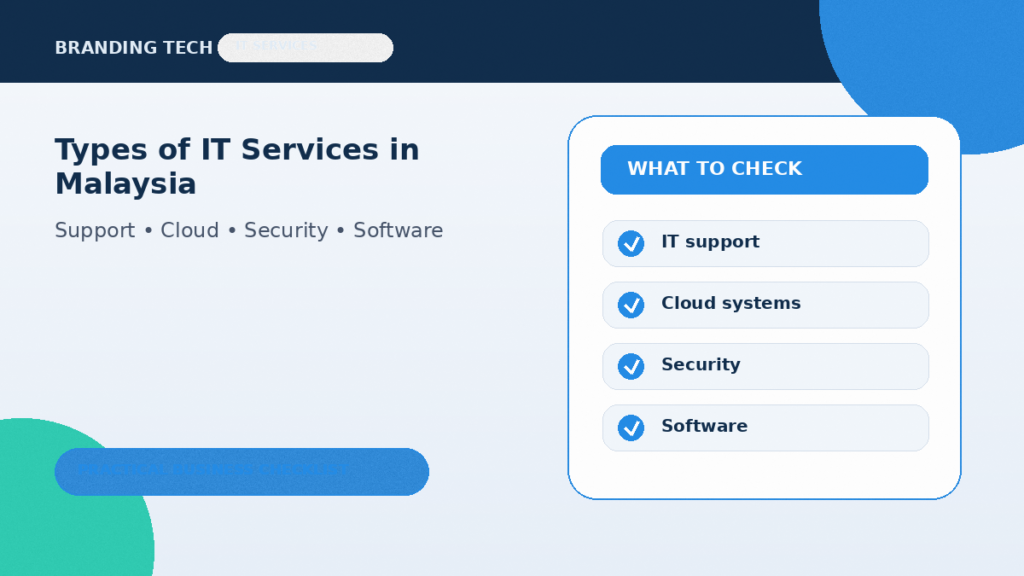
Main types of IT services available to Malaysian businesses.
Ask for work related to your exact need. A provider with strong office support experience may not be suitable for ecommerce or custom software.
Review case studies, demonstrations, or references. Ask what the provider’s own team completed.
A good company asks about users, systems, data, risks, budget, and goals. It should study the current process before recommending major changes.
For larger projects, a discovery or assessment stage helps create a reliable plan.
The scope should list tasks, deliverables, responsibilities, timeline, exclusions, one-time costs, recurring fees, testing, training, and support.
For monthly services, confirm covered users, devices, systems, hours, response times, and visit limits.
Your business should control domains, hosting, cloud accounts, software subscriptions, data, analytics, and administrator accounts.
Give suppliers access based on need. Keep a record of permissions and remove access when it is no longer required.
Ask about two-step login, access rules, updates, backups, monitoring, and incident response. Security must match the type of data and business risk.
Confirm how often backups are created and whether recovery is tested.
The provider should explain technical issues in simple language. Know who manages the account, how staff request help, and when updates are provided.
Clear communication reduces downtime and prevents misunderstandings.
Measures may include response time, system availability, solved issues, fewer manual steps, website leads, online sales, page speed, or reporting time.
Agree on the measures before work begins.
Costs vary widely. Monthly support depends on users, devices, hours, systems, and response level. Projects depend on scope, features, integrations, data, security, and testing.
Separate setup, equipment, licences, hosting, maintenance, training, and optional work. Ask which prices may change when user numbers or usage increase.
Do not compare only the total. A lower quote may exclude support, security, documentation, or testing. Compare the same scope and business risk.
Technology changes after launch. Software needs updates, websites need maintenance, users need help, and business processes improve.
Agree on who will monitor systems, renew licences, maintain backups, update documentation, and review access.
Keep important knowledge inside the business. Your team should understand basic system ownership and know where credentials and documents are stored.
If the provider relationship ends, plan a controlled transfer. Receive current data, files, credentials, documentation, and outstanding issue information.
One mistake is choosing a company because it offers the longest service list. Relevant experience is more important.
Another mistake is allowing the provider to own important accounts. This can make future changes difficult.
Businesses may also automate a poor process. Improve responsibilities and data quality before adding technology.
Some companies do not involve users. Staff who perform the daily work should join discovery and testing.
Finally, do not ignore training. A good system creates little value when people do not know how to use it.
The MDEC Business Digitalisation Initiative provides a framework for businesses to assess digital maturity and improve productivity. It covers customer-facing, operational, and IT areas.
Use this practical approach. Begin with the area that creates the most value, choose a suitable solution, train users, and measure the result.
Businesses specifically comparing nearby development teams can also read the software companies near me guide.
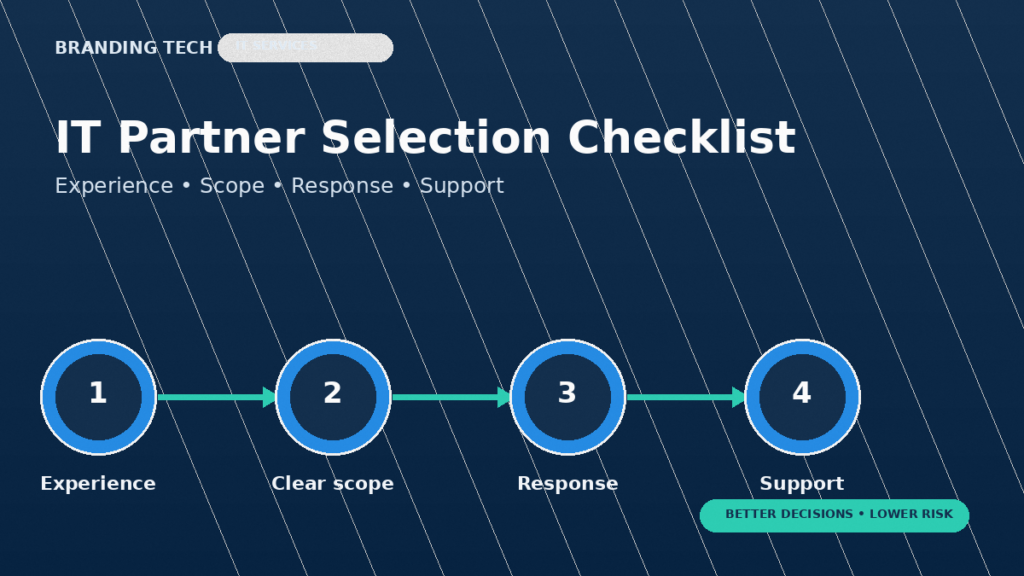
How to compare IT companies in Malaysia.
Branding Tech connects digital technology with customer growth. We provide websites, SEO, digital advertising, branding, content, and AI automation.
We help businesses improve online visibility, collect leads, organise customer communication, and reduce repeated marketing or follow-up work.
We are not a hardware repair or full-time infrastructure monitoring company. For advanced networks, servers, or specialist cybersecurity, choose a provider with that exact expertise.
Services may include technical support, cloud tools, security, software, websites, ecommerce, integrations, automation, and reporting. Each provider has different strengths.
Not always. One partner may manage several connected services, but specialist work may require a specialist provider. Keep responsibilities and account ownership clear.
It can be useful when staff need regular help or important systems require maintenance. Compare the covered services, users, hours, response time, and cost.
Give each provider the same problem statement and requirements. Compare experience, scope, security, ownership, communication, support, price, and results.
The best IT company in Malaysia is the provider that fits your business problem. It should explain the solution clearly, protect your digital assets, and support the work after launch.
Start with one important need. Compare providers using the same questions, keep control of your accounts and data, and measure the result. Practical technology should make the business easier to run and easier for customers to use.